Deja vu? Non, merci!

Yogi Berra famously said, it’s like “deja vu all over again”. Yes, I’m a Yankee fan but even diehard Red Sox fans can agree that deja vu all over again befits the situation in Milton perfectly.

It has been eighteen months to the day since Milton’s town clerk certified signatures to place a question on the ballot seeking to overturn a town meeting vote for the first time in over 50 years. That effort succeeded after a brutal campaign featuring outrageous claims by the forces of “no”. Those claims –from the state won’t sue Milton to we won’t lose any state grants – have proven to be false.

Our intrepid band of NIMBYs kept battling against the odds. Like a gambler at a casino who keeps thinking the next hand will turn the tide, they keep losing and losing big. Today, they lost again…big. Sixteen residents filed suit challenging Milton’s designation as a rapid transit community and, by extension, our requirement to zone for 2,461 units. Just a week ago, they said this was their big chance. A favorable judge, they said. A first chance at “adjudicating” the trolley as rapid transit argument, they said.

“Nope” said the court. The courts have said no all along the way. The legislature has refused to consider amendments to water down the law. The state’s Executive Office of Housing and Livable Communities has been steadfast. A local attorney that wanted the town to file a similar claim declined to take on the case after realizing the Select Board intended to follow the law and the lead of town meeting and submit the newly passed zoning plan to the state for approval.

Milton’s new zoning amendment fully complies with state law. And leaves East Milton, the neighborhood which voted in large majorities to reject the 2023 zoning, largely out of the plan. It is, in many respects, a better plan. A better plan from a planning perspective and a better plan politically.

But Denny Swenson and her acolytes began gathering signatures in earnest on Monday in another attempt to repeal the latest compliant zoning plan passed by town meeting. Deja vu. They can’t win in a forum made up of 279 elected town meeting representatives dominated by well-informed residents. But they proved last February they can win with a well-funded campaign featuring lies, fear and exaggeration. So they attempted to try again.
But you can never exactly recreate the same political environment. Many voters move on. Anger subsides. And towns do face real consequences for ignoring a state law.

Today’s 5pm deadline for signatures came and went and no signatures were filed. Organizers haven’t made a public statement yet but they undoubtedly struggled to reach the required 1,100 signatures need to put this before voters. They definitely had less volunteers this time around. There is anecdotal evidence of better-informed voters declining to sign the petition.

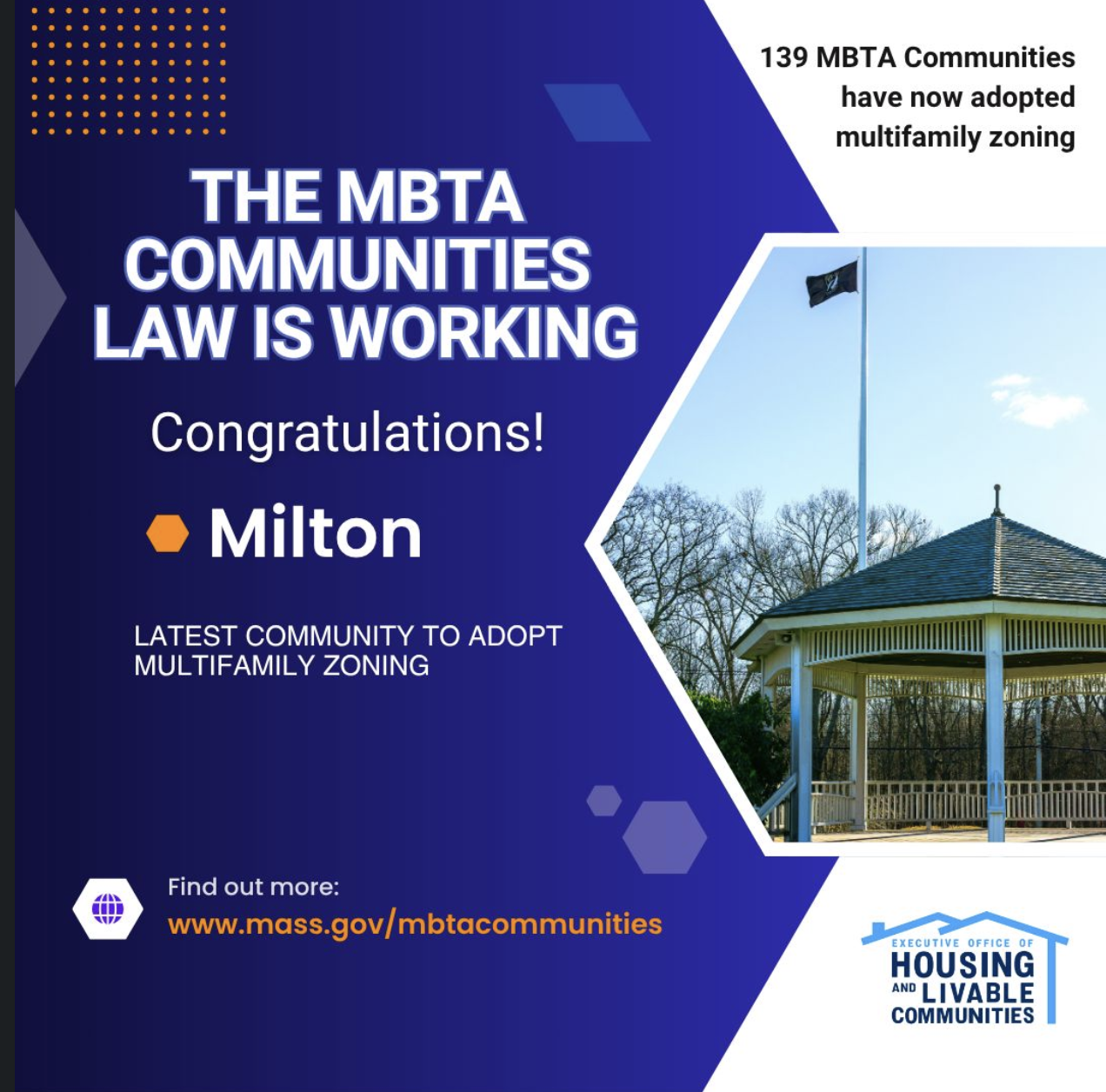
Whatever the reason, the outcome is good for Milton. Inclusivity won. Milton becomes community #139 to comply with a state upzoning law that will not solve our housing crisis, but will become part of a long-term strategy to make our all of our communities a bit more welcoming.

Yogi might say, “it ain’t over ’til it’s over.” Last ditch legal strategies will continue. Political posturing will continue.

But, it is over.

The Pope and the Plan

On May 8, 2025 two momentous events happened. In Rome, the College of Cardinals elected an American Pope. Minutes before the white smoke appeared Vatican experts were on television saying it would never happen. And then it did.

Later that evening in Milton, our Planning Board voted to advance a zoning plan that met the state’s requirements for our town after many of us saying that it would never happen. I believe I heard church bells ringing in town, perhaps celebrating both votes!

While Pope Leo XIV celebrates a week on the job, Milton’s compliant zoning plan didn’t make it that far. On May 13th, our Planning Board took a highly unusual step and rescinded its vote, deciding to advance another plan that is out of compliance with the state law and zones for 60% less housing than the state has required.

Pray for us.

The now-rescinded plan would have brought us into compliance, sparing East Milton residents who voted overwhelmingly against the previous plan in 2024, and creating multi-family zoning districts in more neighborhoods in West Milton. It is not a perfect plan but it is a good, thoughtful plan crafted by Planning Board member Cheryl Tougias (the lone voice of compliance on our Planning Board) and the town’s expert consultants from Utile.

What comes next is anyone’s guess. Milton is at risk of missing yet another state deadline. And being sued once again. And continuing to lose out on state grants, the latest being the loss of a grant for a van for our Council on Aging. Outgoing Select Board member Erin Bradley tallied the total cost to Milton so far as over $1.1 million in legal fees and lost grants.

Pray for us now.

There is hope beyond the prayers. While two incumbents were returned to the Planning Board, two new members were elected to the Select Board and a new Town Moderator was elected as well. Town Meeting is strongly in favor of following the law. But zoning articles must pass through the Planning Board and four of the five members seem to be doing everything in their power to avoid our responsibility to follow a state mandate.

Pray for us.

Pray for a kind and benevolent special master appointed by the Attorney General if we continue to resist. Pray for state officials with short memories when we do eventually comply and the state evaluates funding requests from Milton for vans, schools, public safety, and more. And pray for our neighbors who need more housing options in a town that hasn’t grown in over fifty years. Our population in 1970 was 27,190; today it is 28,811 – a 0.1% annual growth rate. For comparison, neighboring Canton has grown by over 7,000 residents in that time; Sharon over 6,000.

An American Pope and a compliant zoning plan turned out to be too much to expect in one day. But Rome wasn’t built in a day. Milton will be in compliance, consistent with being a rapid transit community. It will be a day in the future. And it will be a day!

ordo amoris

There is sooo much coming out of DC that it is impossible to keep up with and still maintain normal daily activities. But this one may have slipped past a lot of us. Musk and Trump are creating most of the chaos, acting illegally and betting that our court system can’t keep up. But third-wheel JD Vance has been making some news as well.

As many know, Vance converted to Catholicism as an adult in 2019. He was interviewed on Fox recently and invoked the concept of ordo amoris, Augustine’s ordering of loves. Terence Sweeney, a professor at Villanova University, does a much better job than I ever could explaining what Vance got wrong about ordo amoris. Below are excerpts from his column but I encourage you to read it in full in America Magazine.

Sweeney writes, “It is in this context that Vice President JD Vance introduced the idea of the ordo amoris, or ordering of loves, into this discourse. During a Fox News interview, he stated, ‘There is a Christian concept that you love your family and then you love your neighbor, and then you love your community, and then you love your fellow citizens, and then after that, prioritize the rest of the world.'” Vance goes on to say that the left has inverted this, “…they seem to hate the citizens of their own country and care more about people outside of their own borders…”

Sweeney concludes “What Mr. Vance gets wrong is that the point of Christian teaching is to expand, even transform, our order of loves.” Sweeney ends with “The ordo amoris was never about loving less or more narrowly—but about loving more and more widely.”

In Catholic circles, there has been widespread debate. I fall on the side of loving more and more widely. Vance’s comments taken with the actions of this administration to cut funding and programs for poor people near and far calls into question his commitment to ordo amoris, in any order.

Friday Night News Dump

News out of Milton tonight is that a local elected official has filed public comments on the MBTA Communities Act regulations. Ok, that elected official is me! What else would one do on a Friday night in between snow events?

As a Milton resident and elected town meeting member for the past twenty-five years, I write to offer the following comments on MBTA Communities Act regulations.

The updated definition of “Subway station” to include any of the stops along the MBTA Red Line, Green Line, Orange Line, or Blue Line, including but not limited to the Mattapan High Speed Line and any extensions to such lines is a welcome clarification. Our Mattapan trolley fits any reasonable definition of rapid transit because it runs on a frequent and regular schedule and operates on an exclusive right-of-way. Nevertheless, it has been the target of many opponents of this law, drawing much scorn and ridicule as a broken down relic.

Most of those critics in our town don’t ride the trolley. As an occasional rider on the Mattapan trolley, I am able to commute from Milton to downtown Boston in less time than it takes embarking from some of the stops on the Green Line. This dedicated transit line is a valuable resource to Milton residents (as well as Mattapan and Dorchester residents) and clearly qualifies as a subway station for the purposes of this law which is designed to create multi-family housing opportunities close to jobs and transit. The trolley is old and occasionally cranky but it is notable that the MBTA has clear plans to upgrade the trolleys and the line in the coming years. According to the MBTA’s website, over the next eight to 10 years, they will modernize stations and improve infrastructure throughout the Mattapan Line. This includes introducing the next generation of vehicles to the line, the Type 9 light rail vehicles used on the Green Line. Milton is a rapid transit community now and will remain one in the future and should be treated as such under these regulations.

The requirement that Milton and other rapid transit communities create a zoning plan allowing for Multi-family unit capacity equal to or greater than 25% of total housing units is reasonable, especially when you consider that build-out will take many decades and towns may never reach the upper limit of that zoning capacity. Milton must do its part to create housing opportunities in a state where it is increasing hard to afford rents or home prices. Housing supply is vital to our economic health as a town, region and state.

I applaud the provision of the regulations that permits the Executive Office of Housing and Livable Communities, in its discretion, to allow towns to approve a greater percentage of affordable units, or deeper affordability for some or all of the affordable units, if it meets certain conditions. Those conditions are necessary so that so that towns don’t attempt to “game” the system by requiring an affordability percentage that ensures no multi-family housing gets built. But it also allows towns like Milton, where the market is strong, to exceed the 10% affordability requirement and provide more opportunities to low- to moderate-income residents. In fact, this was one of the few areas of agreement between the “yes” and “no” campaigns during last year’s town-wide referendum on the zoning plan passed by Milton town meeting in December 2023. Thank you for providing this important flexibility in the regulations.

Additional flexibility is shown in the regulations by allowing certain communities, including Milton, to craft a Multi-family zoning district with at least 50 percent of the district’s minimum Multi-family unit capacity located within the Transit station area while the remaining capacity can be elsewhere in town. As you know, this was a crucial nod to the Town of Milton since our trolley line is adjacent to Boston and much of our zoning capacity would otherwise be in Boston and not eligible for rezoning by the Town of Milton. I appreciate the state listening to town officials and incorporating this flexibility into the regulations. One size does not fit all and this flexibility is a necessary and welcome relief to communities that have unique circumstances like a trolley line on the town’s border.

My final comment concerns the deadlines that apply to Milton. February 13, 2025 is Milton’s deadline to submit an action plan and July 14, 2025 is our deadline to submit a District Compliance Application. Our town has had several years to comply. Some of our elected officials have not used that time wisely. Certain elected officials in Milton have chosen to litigate instead of legislate. Other communities (117 as of this writing) have chosen to comply and the state should not allow Milton to further delay full compliance. Milton has had enough time to come up with a plan. Now Milton needs to be compelled to do so.