If Bedford Falls had community reinvestment…

New York was the first to pass a state-level Community Reinvestment Act. What would have happened to fictional Bedford Falls (many believe modeled after Seneca Falls, NY) if CRA had been in place in the post World War II era?

You know the Community Reinvestment Act. Signed into law in 1977 by President Jimmy Carter after being championed by Senator William Proxmire (D-Wisconsin), it became one of the last civil rights-era laws passed before the Reagan revolution upended modern politics. It followed on the footsteps of the Equal Credit Opportunity Act (1974) and Fair Housing Act (1968) and other measures designed to end discrimination and rollback policies like redlining. The law states simply that federal regulators “…shall assess the institution’s record of meeting the credit needs of its entire community, including low- and moderate-income neighborhoods, consistent with the safe and sound operation of such institution.”

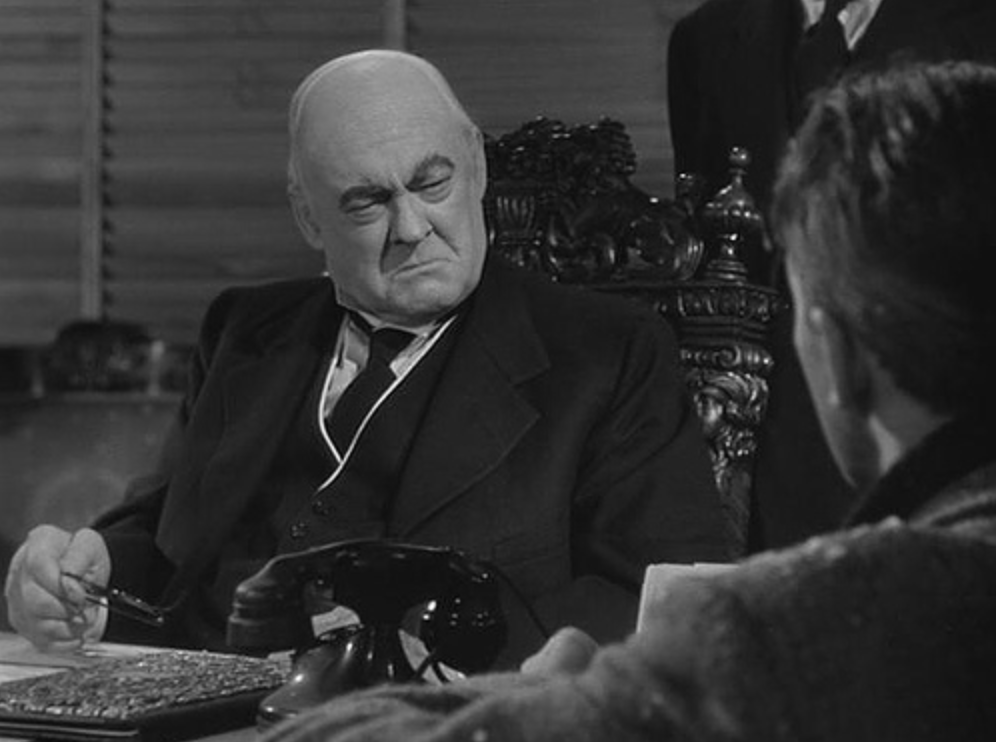
And most of us know the timeless movie It’s A Wonderful Life starring Jimmy Stewart as everyman George Bailey and Lionel Barrymore as the evil banker, Mr. Potter. George as the head of the Bailey Building & Loan who has provided substantial opportunity to the town’s “rabble” in the form of home loans and personal loans presumably not available at the more traditional banking institutions in town. Potter runs an apparently unnamed bank in Bedford Falls and has designs on complete control of the local economy and sees the Bailey Building & Loan as an obstacle.

Let’s speculate a bit and put the Community Reinvestment Act in play here. When George needs help from the other banker in town, he might have offered Mr. Potter a deal that would have earned Potter’s bank considerable Community Reinvestment Act credit. The Bailey Building & Loan was serving the area’s low- to moderate-income residents. George helped the Italian immigrant Giuseppe Martini and his wife buy a home in Bailey Park at a time when Italian-American discrimination was still widespread. He lent George Bishop $5,000 to buy his home so he could “work and pay and live and die in a couple of decent rooms and a bath.”

Who knows? If the movie had continued, would it have been shocking to see Annie, the film’s only Black character with a speaking role, finance a home with a loan from the Bailey’s?
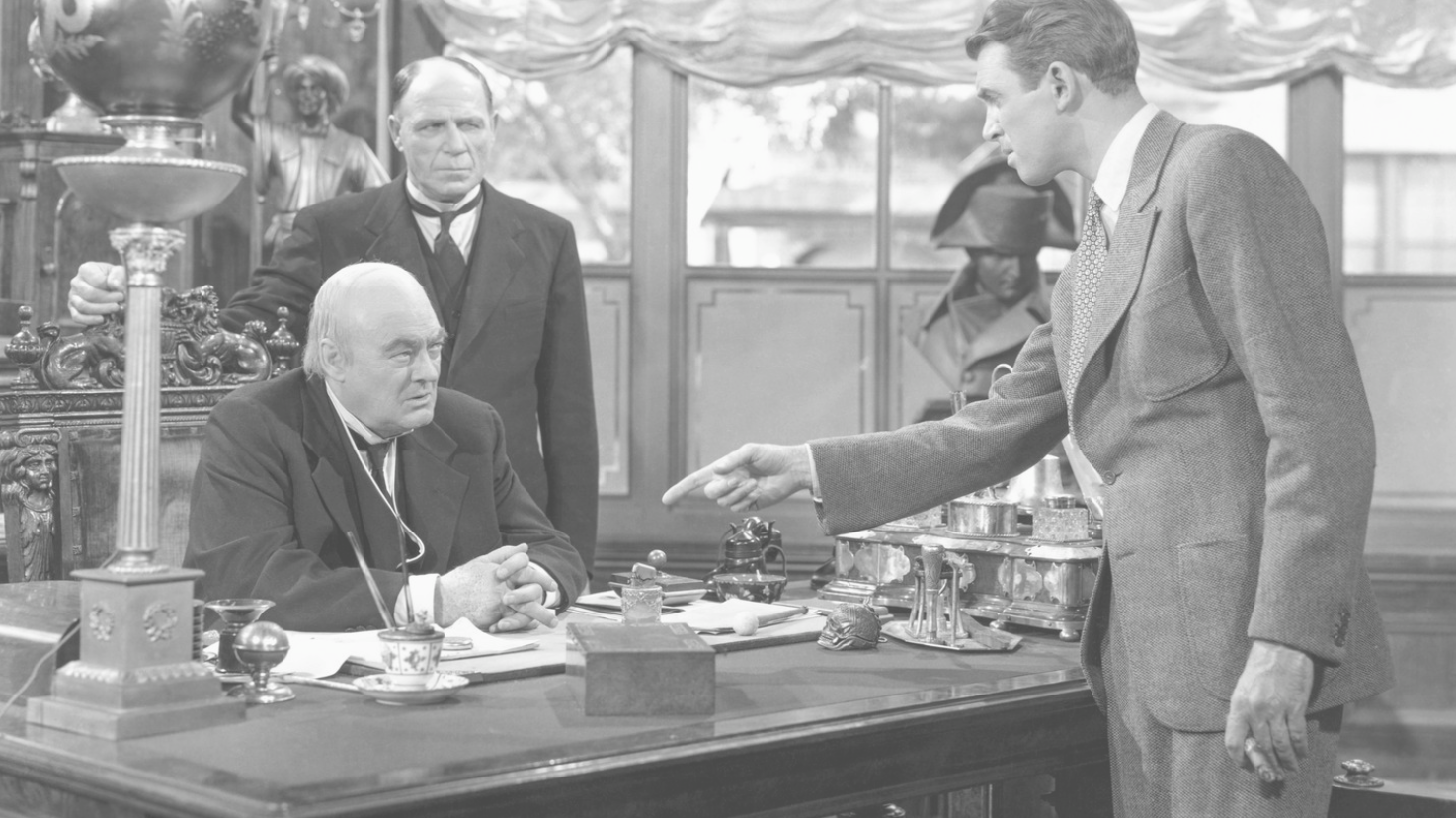
And those pesky bank examiners paying a visit to the Bailey Building & Loan on Christmas Eve? They would likely have been asking Mr. Potter what investments his bank had made in housing and financing the “lazy, discontented rabble” he liked to rail against.

George would have needed the capital that only Potter’s bank could have provided to build out Bailey Park and offer more homeownership opportunities to town residents. Bedford Falls might have welcomed a diverse group of WWII veterans returning home looking to join the growing ranks of the middle class and achieve the American Dream. A CRA in that era might have been just the ticket needed to redeem Mr. Potter and provide a model for those looking to create opportunities for the 1.2 million returning Black veterans that ended up being stymied by the racist implementation of the GI Bill.

Every movie needs a villain but our communities do not. It’s A Wonderful Life without the Potter-Bailey feud would likely make for a less memorable film. But set in the CRA-era, it would be truly wonderful to see what a partnership between George Bailey and Henry Potter could have meant for Bedford Falls. No angels needed.
Guilty!

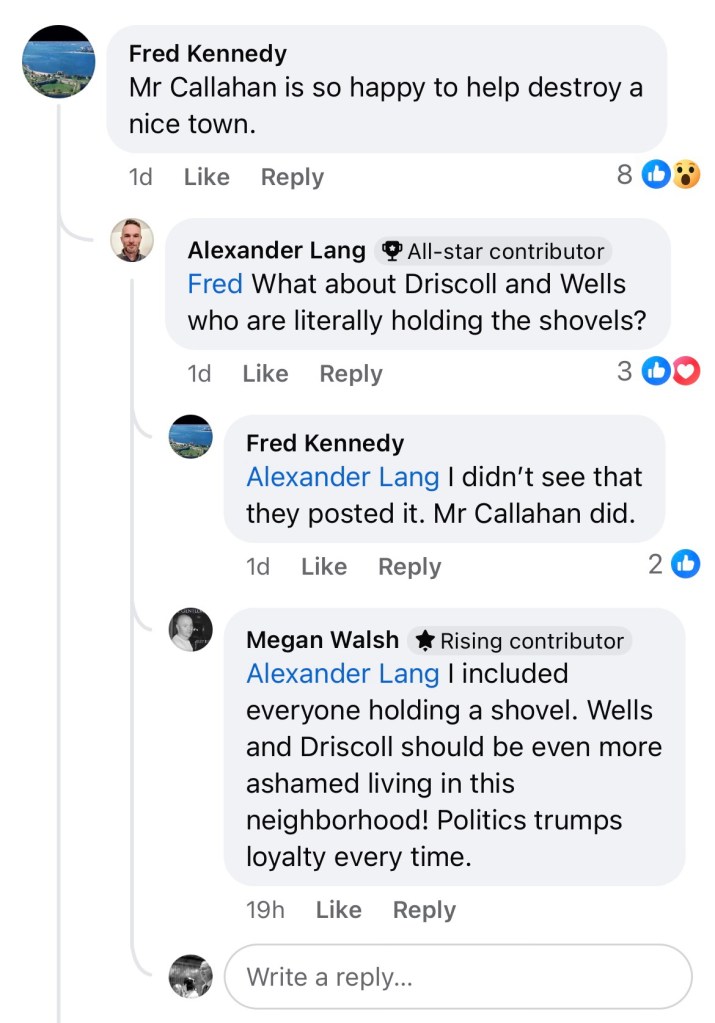
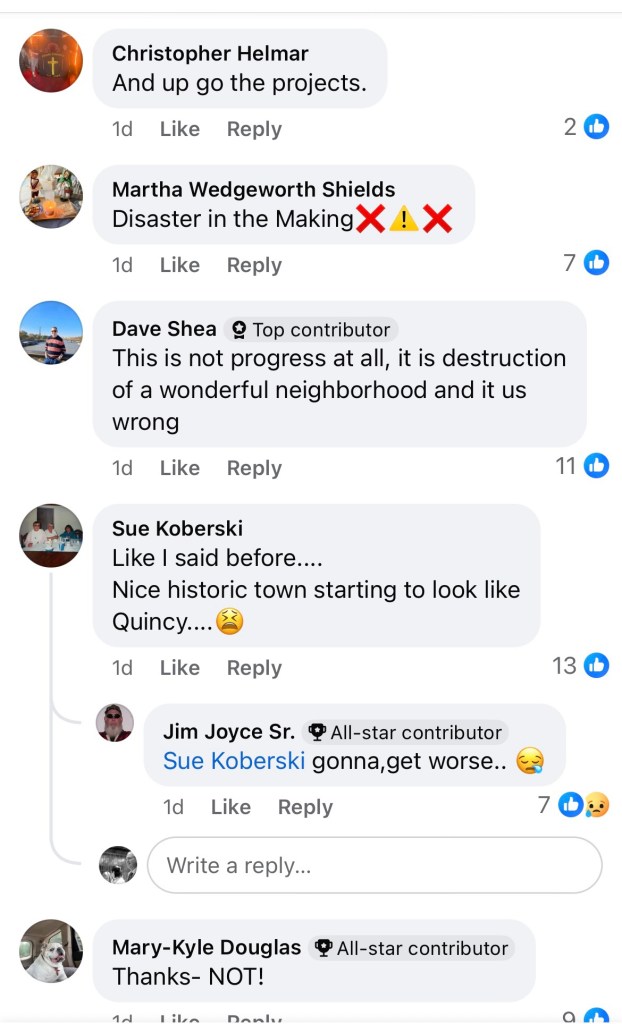
It was a quiet summer in Milton. On Monday, MA Lieutenant Governor Kim Driscoll came to town for a groundbreaking of a 92 unit mixed income apartment building in a formerly under-utilized parcel behind the main business district in East Milton Square. I attended the groundbreaking and then later posted about it on the two main Facebook pages in town – Milton Neighbors and Everything Milton.

Oh boy. The comments flowed…illiberally.

“This is not progress at all, it is destruction of a wonderful neighborhood and it is wrong.”

“And up go the projects.”

“More migrants waited on hand and foot.”

“Can’t wait for the hookers and crack addicts..”

“Mr. Callahan is so happy to destroy a nice town.”

Guilty as charged?! I am happy that this development is moving forward. I’m also happy that the 52 unit Ice House condominiums on the other side (my side) of town are being sold and occupied. Thirteen of the homes will be sold to low-to moderate-income first-time buyers later this summer and fall. I’m happy that we are finally in compliance with the state laws on MBTA Communities and accessory dwelling units.

What the haters fail to appreciate is that new homes will not destroy Milton but rather they will make us a better town. Milton is not on its way to becoming a “city” as many have voiced. But the next generation may have a chance to live in this “nice town” if we continue to add a diverse mix of homes at various price points.

I’m happy our young family chose to move to Milton thirty years ago. I’m happy that we have stayed long after our children have grown up and out. Milton is a nice town (those Facebook comments notwithstanding) and I’m happy that so many of our neighbors work so hard to make sure Milton welcomes neighbors, new and old alike. Find me guilty of that!

Deja vu? Non, merci!

Yogi Berra famously said, it’s like “deja vu all over again”. Yes, I’m a Yankee fan but even diehard Red Sox fans can agree that deja vu all over again befits the situation in Milton perfectly.

It has been eighteen months to the day since Milton’s town clerk certified signatures to place a question on the ballot seeking to overturn a town meeting vote for the first time in over 50 years. That effort succeeded after a brutal campaign featuring outrageous claims by the forces of “no”. Those claims –from the state won’t sue Milton to we won’t lose any state grants – have proven to be false.

Our intrepid band of NIMBYs kept battling against the odds. Like a gambler at a casino who keeps thinking the next hand will turn the tide, they keep losing and losing big. Today, they lost again…big. Sixteen residents filed suit challenging Milton’s designation as a rapid transit community and, by extension, our requirement to zone for 2,461 units. Just a week ago, they said this was their big chance. A favorable judge, they said. A first chance at “adjudicating” the trolley as rapid transit argument, they said.

“Nope” said the court. The courts have said no all along the way. The legislature has refused to consider amendments to water down the law. The state’s Executive Office of Housing and Livable Communities has been steadfast. A local attorney that wanted the town to file a similar claim declined to take on the case after realizing the Select Board intended to follow the law and the lead of town meeting and submit the newly passed zoning plan to the state for approval.

Milton’s new zoning amendment fully complies with state law. And leaves East Milton, the neighborhood which voted in large majorities to reject the 2023 zoning, largely out of the plan. It is, in many respects, a better plan. A better plan from a planning perspective and a better plan politically.

But Denny Swenson and her acolytes began gathering signatures in earnest on Monday in another attempt to repeal the latest compliant zoning plan passed by town meeting. Deja vu. They can’t win in a forum made up of 279 elected town meeting representatives dominated by well-informed residents. But they proved last February they can win with a well-funded campaign featuring lies, fear and exaggeration. So they attempted to try again.

But you can never exactly recreate the same political environment. Many voters move on. Anger subsides. And towns do face real consequences for ignoring a state law.

Today’s 5pm deadline for signatures came and went and no signatures were filed. Organizers haven’t made a public statement yet but they undoubtedly struggled to reach the required 1,100 signatures need to put this before voters. They definitely had less volunteers this time around. There is anecdotal evidence of better-informed voters declining to sign the petition.

Whatever the reason, the outcome is good for Milton. Inclusivity won. Milton becomes community #139 to comply with a state upzoning law that will not solve our housing crisis, but will become part of a long-term strategy to make our all of our communities a bit more welcoming.

Yogi might say, “it ain’t over ’til it’s over.” Last ditch legal strategies will continue. Political posturing will continue.

But, it is over.

The Pope and the Plan

On May 8, 2025 two momentous events happened. In Rome, the College of Cardinals elected an American Pope. Minutes before the white smoke appeared Vatican experts were on television saying it would never happen. And then it did.

Later that evening in Milton, our Planning Board voted to advance a zoning plan that met the state’s requirements for our town after many of us saying that it would never happen. I believe I heard church bells ringing in town, perhaps celebrating both votes!

While Pope Leo XIV celebrates a week on the job, Milton’s compliant zoning plan didn’t make it that far. On May 13th, our Planning Board took a highly unusual step and rescinded its vote, deciding to advance another plan that is out of compliance with the state law and zones for 60% less housing than the state has required.

Pray for us.

The now-rescinded plan would have brought us into compliance, sparing East Milton residents who voted overwhelmingly against the previous plan in 2024, and creating multi-family zoning districts in more neighborhoods in West Milton. It is not a perfect plan but it is a good, thoughtful plan crafted by Planning Board member Cheryl Tougias (the lone voice of compliance on our Planning Board) and the town’s expert consultants from Utile.

What comes next is anyone’s guess. Milton is at risk of missing yet another state deadline. And being sued once again. And continuing to lose out on state grants, the latest being the loss of a grant for a van for our Council on Aging. Outgoing Select Board member Erin Bradley tallied the total cost to Milton so far as over $1.1 million in legal fees and lost grants.

Pray for us now.

There is hope beyond the prayers. While two incumbents were returned to the Planning Board, two new members were elected to the Select Board and a new Town Moderator was elected as well. Town Meeting is strongly in favor of following the law. But zoning articles must pass through the Planning Board and four of the five members seem to be doing everything in their power to avoid our responsibility to follow a state mandate.

Pray for us.

Pray for a kind and benevolent special master appointed by the Attorney General if we continue to resist. Pray for state officials with short memories when we do eventually comply and the state evaluates funding requests from Milton for vans, schools, public safety, and more. And pray for our neighbors who need more housing options in a town that hasn’t grown in over fifty years. Our population in 1970 was 27,190; today it is 28,811 – a 0.1% annual growth rate. For comparison, neighboring Canton has grown by over 7,000 residents in that time; Sharon over 6,000.

An American Pope and a compliant zoning plan turned out to be too much to expect in one day. But Rome wasn’t built in a day. Milton will be in compliance, consistent with being a rapid transit community. It will be a day in the future. And it will be a day!

Send it back

Two nights of town meeting and two nights of dysfunction. Milton has been renamed Dysfunction Junction (with several rapid transit stations naturally!).

Last night, we sent two articles back to the Planning Board for more work including one on Accessory Dwelling Units. State law mandates ADUs in single-family districts now but towns can place “reasonable” restrictions on them. Town meeting determined that the article before us was not reasonable, including requiring more of those who wish to add a 900 square foot ADU than those wanting to build a 5,000 square foot McMansion. It was sent back for more work.

A site plan review article was sent back to the Planning Board. Two other articles were sent back to the Select Board. Town meeting members sent back 4 of 13 articles that were initiated by town bodies.

We did close town meeting with a bang however. Debate on Articles 14 and 15 came late, going until 11:15pm. Article 14 was a citizens petition to transfer $24.61 (a penny for every zoned unit called for by the MBTA CA) from the town’s legal budget to the schools. A symbolic shot across the bow of a town that is paying lawyers $940 per hour to defend us against the Attorney General. Article 15 was a non-binding citizens petition signed by over 200 residents that asked for the Planning Board to do its job and comply with the MBTA Communities Act.

The debate was fiery. Sad. Disquieting. Three leaders of the “no” campaign took to the floor to double-down. The loss for the town in the Supreme Judicial Court was actually a win. Their greatest hits were played again. The no side really does want more affordable housing. The yes side doesn’t listen. Rapid transit is not rapid enough. It was angry, rambling and at times unhinged. Our moderator interrupted a town meeting member and reminded him to “not cast aspersions” but relented when the speaker told him he was casting aspersions on state government. That’s okay I guess. A heckler saying the “whole game is rigged” in a Trump-like rant from the cheap seats. The lead “no” organizer doing a commercial for her political operation. And the advertising executive turned affordable housing expert railing away and lying to the body by saying, three times for effect, “there is no provision for affordable housing in the MBTA Communities Act.” There is.

Not a great night. One hopeful sign was the overwhelming support for our public schools over the two nights. Both articles addressing our school overcrowding passed with huge majorities. We will need that unity this spring as Milton will vote on an override to stave off job cuts for our teachers and public safety personnel. Our divide on housing is real and deep. Our next test is to come together in support of a yes for our schools and town government services amidst the national anti-government environment. Godspeed, Milton.

Milton and smallpox

A break, of sorts, from housing politics (although more coming on that soon). I learned this morning from Milton Historical Commission members Meredith Hall and Steve O’Donnell that the town of Milton became part of the first municipal effort in the United States to offer free vaccination to residents as part of the early efforts to eradicate smallpox. This excellent article on the website of the National Museum of American History details the role of Milton and its residents.

“Over three hundred persons were inoculated during a three-day campaign in July. Following this program, the town leaders took an unusual step—they decided to hold a public demonstration to prove without a doubt that cowpox vaccine offered protection from smallpox. On October 9, 1809, twelve children, selected from those vaccinated in July, were inoculated with fresh, virulent smallpox matter by Dr. Amos Holbrook and witnessed by eighteen town members. The children were confined to a single home for fifteen days and on October 25 were discharged with no sign of smallpox infection.”

“In 1810 the State of Massachusetts passed the Cow Pox Act directing every town, district, or plantation, within the Commonwealth, to provide for the vaccination of their inhabitants. The world is now free of small pox—a remarkable global achievement that owes a small debt to the citizens in a little town in New England in the early years of our republic.”

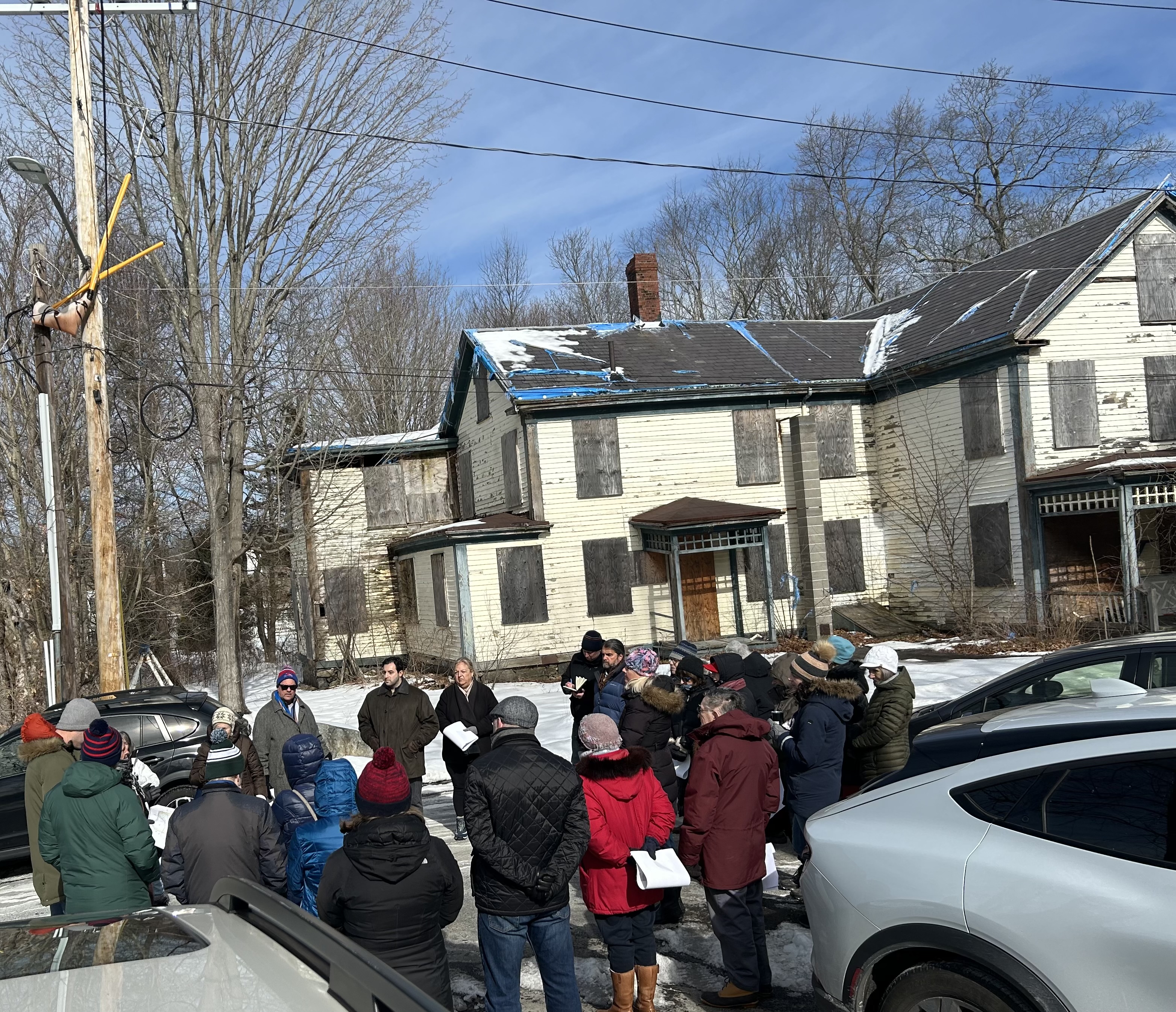
Why were we talking about smallpox this morning? It came up on a site walk organized by the Town Farm review committee charged with making a recommendation for the future use of the historic poor farm deeded to the town in 1701 by Royal Governor William Stoughton. We walked past the 1888 “pest house” which was used to quarantine people with infectious diseases. Pest houses were alternately called plague houses, fever sheds, or pestilence houses.

About twenty-five Milton residents braved the cold temperatures this morning to learn more about the site and its history of providing housing for the town’s poor. Three structures from the 19th century – the main almshouse, men’s almshouse along with the pest house – still remain although in very bad condition. Two developers have responded to the town’s Request for Proposals with plans to build 35 units of affordable housing on the site respecting the historic nature of the site. I did say a break, of sorts!

Friday Night News Dump

News out of Milton tonight is that a local elected official has filed public comments on the MBTA Communities Act regulations. Ok, that elected official is me! What else would one do on a Friday night in between snow events?

As a Milton resident and elected town meeting member for the past twenty-five years, I write to offer the following comments on MBTA Communities Act regulations.

The updated definition of “Subway station” to include any of the stops along the MBTA Red Line, Green Line, Orange Line, or Blue Line, including but not limited to the Mattapan High Speed Line and any extensions to such lines is a welcome clarification. Our Mattapan trolley fits any reasonable definition of rapid transit because it runs on a frequent and regular schedule and operates on an exclusive right-of-way. Nevertheless, it has been the target of many opponents of this law, drawing much scorn and ridicule as a broken down relic.

Most of those critics in our town don’t ride the trolley. As an occasional rider on the Mattapan trolley, I am able to commute from Milton to downtown Boston in less time than it takes embarking from some of the stops on the Green Line. This dedicated transit line is a valuable resource to Milton residents (as well as Mattapan and Dorchester residents) and clearly qualifies as a subway station for the purposes of this law which is designed to create multi-family housing opportunities close to jobs and transit. The trolley is old and occasionally cranky but it is notable that the MBTA has clear plans to upgrade the trolleys and the line in the coming years. According to the MBTA’s website, over the next eight to 10 years, they will modernize stations and improve infrastructure throughout the Mattapan Line. This includes introducing the next generation of vehicles to the line, the Type 9 light rail vehicles used on the Green Line. Milton is a rapid transit community now and will remain one in the future and should be treated as such under these regulations.

The requirement that Milton and other rapid transit communities create a zoning plan allowing for Multi-family unit capacity equal to or greater than 25% of total housing units is reasonable, especially when you consider that build-out will take many decades and towns may never reach the upper limit of that zoning capacity. Milton must do its part to create housing opportunities in a state where it is increasing hard to afford rents or home prices. Housing supply is vital to our economic health as a town, region and state.

I applaud the provision of the regulations that permits the Executive Office of Housing and Livable Communities, in its discretion, to allow towns to approve a greater percentage of affordable units, or deeper affordability for some or all of the affordable units, if it meets certain conditions. Those conditions are necessary so that so that towns don’t attempt to “game” the system by requiring an affordability percentage that ensures no multi-family housing gets built. But it also allows towns like Milton, where the market is strong, to exceed the 10% affordability requirement and provide more opportunities to low- to moderate-income residents. In fact, this was one of the few areas of agreement between the “yes” and “no” campaigns during last year’s town-wide referendum on the zoning plan passed by Milton town meeting in December 2023. Thank you for providing this important flexibility in the regulations.

Additional flexibility is shown in the regulations by allowing certain communities, including Milton, to craft a Multi-family zoning district with at least 50 percent of the district’s minimum Multi-family unit capacity located within the Transit station area while the remaining capacity can be elsewhere in town. As you know, this was a crucial nod to the Town of Milton since our trolley line is adjacent to Boston and much of our zoning capacity would otherwise be in Boston and not eligible for rezoning by the Town of Milton. I appreciate the state listening to town officials and incorporating this flexibility into the regulations. One size does not fit all and this flexibility is a necessary and welcome relief to communities that have unique circumstances like a trolley line on the town’s border.

My final comment concerns the deadlines that apply to Milton. February 13, 2025 is Milton’s deadline to submit an action plan and July 14, 2025 is our deadline to submit a District Compliance Application. Our town has had several years to comply. Some of our elected officials have not used that time wisely. Certain elected officials in Milton have chosen to litigate instead of legislate. Other communities (117 as of this writing) have chosen to comply and the state should not allow Milton to further delay full compliance. Milton has had enough time to come up with a plan. Now Milton needs to be compelled to do so.