Friday Night News Dump

News out of Milton tonight is that a local elected official has filed public comments on the MBTA Communities Act regulations. Ok, that elected official is me! What else would one do on a Friday night in between snow events?

As a Milton resident and elected town meeting member for the past twenty-five years, I write to offer the following comments on MBTA Communities Act regulations.

The updated definition of “Subway station” to include any of the stops along the MBTA Red Line, Green Line, Orange Line, or Blue Line, including but not limited to the Mattapan High Speed Line and any extensions to such lines is a welcome clarification. Our Mattapan trolley fits any reasonable definition of rapid transit because it runs on a frequent and regular schedule and operates on an exclusive right-of-way. Nevertheless, it has been the target of many opponents of this law, drawing much scorn and ridicule as a broken down relic.

Most of those critics in our town don’t ride the trolley. As an occasional rider on the Mattapan trolley, I am able to commute from Milton to downtown Boston in less time than it takes embarking from some of the stops on the Green Line. This dedicated transit line is a valuable resource to Milton residents (as well as Mattapan and Dorchester residents) and clearly qualifies as a subway station for the purposes of this law which is designed to create multi-family housing opportunities close to jobs and transit. The trolley is old and occasionally cranky but it is notable that the MBTA has clear plans to upgrade the trolleys and the line in the coming years. According to the MBTA’s website, over the next eight to 10 years, they will modernize stations and improve infrastructure throughout the Mattapan Line. This includes introducing the next generation of vehicles to the line, the Type 9 light rail vehicles used on the Green Line. Milton is a rapid transit community now and will remain one in the future and should be treated as such under these regulations.

The requirement that Milton and other rapid transit communities create a zoning plan allowing for Multi-family unit capacity equal to or greater than 25% of total housing units is reasonable, especially when you consider that build-out will take many decades and towns may never reach the upper limit of that zoning capacity. Milton must do its part to create housing opportunities in a state where it is increasing hard to afford rents or home prices. Housing supply is vital to our economic health as a town, region and state.

I applaud the provision of the regulations that permits the Executive Office of Housing and Livable Communities, in its discretion, to allow towns to approve a greater percentage of affordable units, or deeper affordability for some or all of the affordable units, if it meets certain conditions. Those conditions are necessary so that so that towns don’t attempt to “game” the system by requiring an affordability percentage that ensures no multi-family housing gets built. But it also allows towns like Milton, where the market is strong, to exceed the 10% affordability requirement and provide more opportunities to low- to moderate-income residents. In fact, this was one of the few areas of agreement between the “yes” and “no” campaigns during last year’s town-wide referendum on the zoning plan passed by Milton town meeting in December 2023. Thank you for providing this important flexibility in the regulations.

Additional flexibility is shown in the regulations by allowing certain communities, including Milton, to craft a Multi-family zoning district with at least 50 percent of the district’s minimum Multi-family unit capacity located within the Transit station area while the remaining capacity can be elsewhere in town. As you know, this was a crucial nod to the Town of Milton since our trolley line is adjacent to Boston and much of our zoning capacity would otherwise be in Boston and not eligible for rezoning by the Town of Milton. I appreciate the state listening to town officials and incorporating this flexibility into the regulations. One size does not fit all and this flexibility is a necessary and welcome relief to communities that have unique circumstances like a trolley line on the town’s border.

My final comment concerns the deadlines that apply to Milton. February 13, 2025 is Milton’s deadline to submit an action plan and July 14, 2025 is our deadline to submit a District Compliance Application. Our town has had several years to comply. Some of our elected officials have not used that time wisely. Certain elected officials in Milton have chosen to litigate instead of legislate. Other communities (117 as of this writing) have chosen to comply and the state should not allow Milton to further delay full compliance. Milton has had enough time to come up with a plan. Now Milton needs to be compelled to do so.

Never gonna give you up

“Never gonna give you up
Never gonna let you down
Never gonna run around and desert you
Never gonna make you cry
Never gonna say goodbye
Never gonna tell a lie and hurt you“

– Rick Astley, 1987

At last night’s Milton Town Farm review committee, our first meeting after being appointed last August, I learned about a couple of new readers of this blog. Those readers don’t like my blog posts [but they do boost my stats – thank you]. And some of those readers think I should give you up. More specifically, they don’t appreciate my coverage of town committees and boards and my critique of certain actions and statements made by elected officials and activists in town.

Up until last night, it had been a good week for bloggers. Trump’s new press secretary invited bloggers to apply for White House press corps credentials. No worries. I’m never going give you up. I’ve written for publication for nearly 50 years and bad reviews have not stopped me before and won’t now.

What happened last night other than the fifteen minute convo on my blogging? I lost a vote to become vice-chair of the committee. C’est la vie. We set a next meeting date of March 12th at 7pm and a Saturday, February 22 site walk at 10am. And we had a very preliminary discussion about Request For Proposals, geological surveys, traffic studies, affordable housing, fiduciary responsibilities and serving the poor. All very respectful and professional, bloggers notwithstanding.

Watch this space. And for those who are reading this for a Rick Astley fix, here you go.

State mandates at work

Tonight is yet another meeting of the Milton Planning Board (four of five members are opposed to MBTA Communities Act compliance). Before they discuss whether or not to submit an action plan that states that the town intends to comply with the emergency regulations, they discuss an ADU zoning article. The state, of course, has forced Milton’s (and every other town’s) hand and legalized ADUs in single family zoning districts statewide. The debate about drafting an ADU zoning article hit a bump in the road when the PB discovered that the state had a definition of subway in the regulations. Uh oh. That definition of subway included our mighty trolley.

The loyal opposition was loathe to concede an inch. Planning Board member Sean Fahy took to google to come up with his preferred subway definition. Google does not mention the Mattapan trolley. Neither does the Bible, Torah and any religious text.

What a web they weave! “We don’t have a subway station, arguably,” said Maggie Oldfield. Hmm. Almost sounds like a concession. “It’s a trolley stop not a trolley station.” “I’ve lived in this town for 56 years…” Let’s vote on this. A 3-2 vote. Members Fahy, Davis and Oldfield vote for using “stop”, not “station” as the state suggests. Jim Davis admits that the Attorney General will reject what they just voted on.

And then finally another vote. Nearly three years after the forces of “no” killed an ADU article at town meeting, and subsequently promised to bring another one back in a few months, the Milton Planning Board tonight voted unanimously to submit an ADU article to the February special town meeting…after being forced by the state. State mandates do work!

Winter always turns to spring

“In May 1275, Nichiren Daishonin composed this letter, now famously titled “Winter Always Turns to Spring,” to the lay nun Myoichi.” The quote is a core principle for many Buddhists over the centuries.

It came to my attention last night because Jaylen Brown used it in an interview after the Boston Celtics returned to Dallas after last year’s NBA Finals and beat the Mavericks…again.

We are in winter still.

Milton is preparing for town elections this spring where once again, two of five seats on our Select Board are up for election. With a 3-2 split board in favor of continued resistance to the MBTA Communities Act, each election means a possibility of a shift in priorities come May.

How have voters reacted to the town spending $300,000 challenging Governor Healey and Attorney General Campbell at the Supreme Judicial Court? No one knows. Both sides claimed victory in the SJC decision handed down on January 8th but most observers saw it as a clear victory for compliance with the law, once the “guidelines” are turned into “regulations”. Healey’s team issued emergency regulations a few days later to clarify for the 117 towns already in compliance that the same rules continue to apply. The old guidelines came as a result of a lengthy public process that spanned from when they were issued on August 10, 2022, revised on October 21, 2022 and revised again on August 17, 2023 after substantial public comment. The state now must promulgate regulations consistent with the Administrative Procedures Act.

Leaders of “no” efforts in a number of communities clearly see an opportunity to influence the state to substantially change the regulations but it is hard to see the state winning in court only to concede to the town that is trying to challenge the state’s authority to implement the law.

What do Milton opponents want? MBTA Communities Act guidelines call for the town to zone for 2,461 units. Leaders of the Milton Vote No campaign want that number reduced to what they call a “middle ground” of 550, all presumably in the southwest portion of town near the Hyde Park commuter rail stations. It is hard to imagine the state agreeing to that amidst a housing supply crisis that is not abating.

But Denny Swenson‘s “foot soldiers” believe they have the momentum. Towns, at least the towns they talk to regularly, are rising up against the state believing that their they should be given special consideration.

The SJC clearly said the law is constitutional and the AG can enforce it. 117 towns have already complied. More are poised to join them this year. States around the country like California, Connecticut, Oregon, Washington, Utah, and Maine have passed laws encouraging greater housing supply with many targeting “upzoning” as a key piece of the puzzle. How many more taxpayer dollars are the no leaders willing to spend on a legal fight with the Commonwealth? How long can they try to delay the inevitable? Milton, like 176 other communities, will have to fully comply with the law. Spring is coming.

Morning, Milton

Not good morning. But morning.

This is the first of what I hope will be a regular way to chronicle our tumultuous times. Not just with the chaos caused by Trump but with our own conservative-led NIMBY movement in our diverse town of 28,374 on Boston’s southern border.

I thought 1-25-25 was a good day to start these regular blog posts. Five days after the beginning of Trump part two and five days before the first meeting of the Milton Town Farm review committee which is charged with making a recommendation for the last four acres of one of New England’s few surviving poor farms.

We will be writing a lot about both, I suspect, as well as our town’s ongoing efforts to break the law, notably the MBTA Communities Act. Writing helps me process and make sense of what often is hard to understand.

My writing career began in college when I penned op-ed articles for our campus paper, the Fairfield Mirror. Since then, I’ve written countless grant proposals and was even second or third author on a couple of academic papers. Heck, I even wrote a chapter in a book called Organizing Access To Capital: Advocacy And The Democratization. This won’t be Heather Cox Richardson writing every day. I’m not that smart nor prolific. But there is too much going on. I need to capture this in real time as outrage turns to action and action yields progress. Onward.

It was the maple syrup

There has been a lot written about Jack Connors in the last week. And deservedly so.

Jon Chesto today wrote a column about who will be the next Jack Connors and ultimately concluded on no one. Very few of us can’t be replaced but Mr. Connors is one of those unique individuals that brought together such a cross-section of Boston that is unlikely to be replaced anytime soon.

My Jack Connors story includes maple syrup, one of my favorite foods. Pancakes or waffles? Both as long as it includes real Vermont maple syrup.

I met Mr. Connors in 2001 when a mutual friend introduced us because Jack wanted to hear more about our campaign to pass the Community Preservation Act in Boston. We made the trip to the 60th floor of the Hancock tower and entered the suite that was his office and home to the Connors Family Foundation. He asked some hard questions about the campaign and our plan to win and later pledged to help our efforts, quietly but effectively.

That campaign, ultimately, was not successful when 9/11 happened and Fidelity Investments CEO Ned Johnson became one of the few business leaders not swayed by our arguments that CPA would be good for Boston.

Fast forward fifteen years and we found ourselves in the same office with a Jack Connors that had the same fire in the belly to rectify a wrong. He signed on to the campaign again and, one more time, lobbied his colleagues and helped us raise money. He kept asking great questions about our campaign and was the quiet power behind our efforts.

At the end of one of those meetings on the 60th floor, he disappeared to a room or closet off of the office and returned with several bottles of maple syrup. A personal stash of maple syrup from his farm in Vermont. A totally unexpected but very personal thank you to those of us working for a better Boston.

That was Jack Connors. He knew the powerful in Boston and knew how to challenge elected officials, business executives and religious leaders alike. He put his stamp on causes like Camp Harbor View in highly visible ways and helped passed the Community Preservation Act in Boston with a quiet, effective, behind the scenes effort. But if you were lucky enough to know Jack Connors, he would show his kindness and gentleness in many ways, not the least of which was handing you a bottle of maple syrup from his office in Boston or out of the trunk of his car down the Cape.

Today is his funeral at St. Ignatius of Loyola at Boston College. He will be laid to rest surrounded by family, friends and flowers from the likes of Joe and Jill Biden as well as from those he helped along the way. Let us all strive to be a little more like Jack Connors and the Ignatius prayer that is on his Mass card.

Dearest Lord, teach me to be generous;
teach me to serve You as You deserve,
to give and not to count the cost,
to fight and not to heed the wounds,
to toil and not to seek for rest,
to labor and not to seek reward,
except that of knowing that I do Your Will.

Amen.

Valentine’s Day Fireworks

Reportedly, there were fireworks in East Milton last night. For real. A spontaneous celebration of NO!

Milton voters rejected a zoning plan that would have added multi-family housing options in Milton and brought us into compliance with state law. Fifty-four percent of voters yesterday chose to break the law and break with two-thirds of town meeting members because they feared the consequences of growth and new housing would be worse, much worse.

It is a sobering setback for those of us in Milton who believe in a more inclusive town and region. We didn’t know if we would win and we certainly knew that the opposition had the easier sell. Think traffic is bad now? Voting yes will make it worse, they said. Greedy developers. An influx of outsiders. Fear of change. Fear of the other. Powerful messaging.

So, we put together a powerful coalition of long-time residents and newcomers to town that voted yes for a wide variety of reasons. 4,346 residents said yes at the polls for playing our part in the regional housing crisis and for continuing to partner with the state on funding and planning. Over 4,000 yes votes wins virtually every municipal election in Milton history. But not yesterday.

Turnout in last year’s hotly contested spring elections in Milton was 28%. Yesterday’s turnout exceeded 45%. In the large turnout presidential election years of 2016 and again in 2020, over 4,000 Milton residents voted for Donald Trump. But three times that number voted for Biden in 2020 making the Trump total seem insignificant. Analysis will need to be done, but it does seem as if those Trump voters came out yesterday. In force. They joined with others wanting to send a signal to state officials who they believe are inappropriately forcing Milton to change.

The no voters were led by former Canton resident Denny Swenson. Swenson “moved” to Milton in 2013 seven years after buying a home literally on the Canton/Milton line with half of the home in each town. She lived her first years there as a Canton resident sending her daughter to Canton schools and voting in Canton elections. In 2013, a developer proposed a mixed-income apartment building in Milton near her neighborhood. Swenson registered to vote in Milton, fought the development and won, ran for town meeting and then planning board. After five unremarkable years on the Planning Board, including a stint as chair while the state was drafting guidelines for the MBTA Communities Act, Swenson orchestrated a successful campaign to convince East Milton voters that they were the town’s “dumping ground”.

She lied to voters repeatedly saying, among other fibs, that the only money at risk was a $35,000 state grant. In the immediate hours after the vote, the town has already lost a $140,800 grant designed to protect a seawall at Milton Landing. More bad funding news is sure to come if Milton continues its noncompliance.

Swenson was brilliant politically. Our side played early on with the theme of “no has no plan” highlighting that only one side of the debate had done the work to put forward a zoning plan meeting the state’s guidelines. Swenson flipped that on its head and sent a mailer to town residents saying it was the yes side, who had spent 18 months crafting an imperfect but carefully crafted compliant zoning article, that had no plan. No plan for traffic, school funding, reigning in greedy developers, and quite shockingly and incorrectly, no plan for increasing the amount of affordable housing.

What will Swenson and her motley coalition do now? Time will tell but my guess is that they will double down on the argument that Milton is not a rapid transit community. They will seek to litigate that issue and try to get Milton’s zoning requirement downgraded from approximately 2,400 units to under 1,000. It is unlikely to be successful but it allows her angry followers, disproportionately older white males among her visible volunteers, to continue to shake their collective fists at the state bogeyman, or rather the bogeywomen, of Governor Maura Healey and Lt. Governor Kim Driscoll.

What should Swenson do? She and her allies on the Planning Board (four of five PB members voted against this zoning) should come up with a Plan B that is state compliant. And see if they can win approval from Town Meeting and/or town voters for a detailed specific plan that puts more housing in someone’s neighborhood. In every other town that has voted on MBTA Community zoning thus far, voters have had a choice of at least two different plans from YIMBY and NIMBY advocates. Milton’s no side refused to develop a plan and won yesterday with that strategy. You can’t criticize a plan that doesn’t exist. It is easy to coalesce around a request for “more time to get it right”. But it is not a governing strategy. At some point, a new plan will have to emerge or the state will choose one for us.

Milton tripled in population from approximately 9,000 residents in 1920 to 27,000 fifty years later in 1970. In the 54 years since, Milton has largely shut its doors to new growth. Our population has grown by just 1,100 people since 1970. In that time, Milton’s neighboring communities of Dorchester, Mattapan, Hyde Park and Quincy have gotten more diverse. Milton’s diversity has increased as well, with three of ten residents being persons of color, a dramatic difference from 1970. Does growing diversity mean we can stop growing as a town? Do we have any responsibility to address the growing unaffordability of a town where the median single family home is $1.1 million?

Local control works for those on just one side of the door. White homeowners vote over and over to exclude others. Existing homeowners perceive threats to their economic interests with every proposed change no matter how large or small, how borne out by fact or not. Civil rights groups will take note. Our Attorney General has been clear in her statements. Milton must follow the law. 5,119 voters put the target on our back yesterday. Let’s see if the no side is deft enough to avoid what is coming next.

A night to remember

Timberwolves vs. Celtics on a Wednesday night in Boston. The team with the best record in the West playing the team with the best record in the NBA. My sister and brother-in-law are in town with tickets to the game.

Boston leads for the entire first half. Minnesota roars back in the third quarter but it is a close, exciting game. Timberwolves take their largest lead of the game, 106-97 with just 3:35 left in the fourth quarter.

Decision time for the Celtics and for me. Do the Celtics turn up the defensive pressure and dial in the offense? Do I leave the house to pick up my sister and BIL knowing that I will miss any comeback, however improbable that may be?

Both questions are answered in the affirmative. I get on the highway, leaving the house at 9:06pm. Shortly thereafter, Jason Tatum and company get to work. I listen to Sean Grande and Cedric Maxwell call the exciting finish.

9:30pm: I arrive at our designated meeting spot a few blocks from TD Garden. Jason Tatum misses a 20 foot jumper and the game goes to overtime. Ugh.

I find a nearby parking spot and turn off the car and listen to the radio broadcast of overtime, using accessory mode on our Honda HRV.

9:43pm: Game ends. Celtics complete a thrilling, regular season instant classic and win going away 127-120.

9:45pm: I try to start the car and the dashboard lights up like a Christmas tree. Do we really have that many icons on our instrument panel?? Car is not starting. What is going on? This four year old car, purchased on the eve of the pandemic, has never given us a hint of a problem. I try again…and again. No go.

9:55pm: I call Eileen at home to get our AAA card number.

9:56pm: My sister and BIL arrive at designated meeting spot but I’m not there.

10:02pm: Tom calls AAA.

10:04pm: AAA schedules service call. Help is three hours away!

10:05pm: I reconnect on foot with my sister and BIL. We together try to start car, and then clean the battery connection. Nothing works. Randomly, dashboard lights come on and off without us activating anything in the car.

11:11pm: AAA arrives at car. Three hours turned into one. Technician says he thinks it is not a dead battery just a battery where the connections are corroded. He’s wrong. Battery is dead.

11:29pm: Car starts after jump start from AAA.

11:34pm: All downtown entrances to 93 South towards are closed for maintenance. Are you kidding me?

11:37pm: Car is running fine (I think) but won’t stop beeping at us, loudly. Every light on dashboard is still lit and flashing. Computers!

11:59pm: We arrive safely home in Milton.

12:00am: We take bets to see if car, still beeping loudly, starts again after turning off.

12:01am: Car starts again

12:15am: I watch the replay of overtime on my sister’s phone.

12:20am: Eileen schedules appointment at dealer for her beloved, but unreliable for a night, HRV.

Post-game analysts call it the best game of the year. What a night! Indeed.

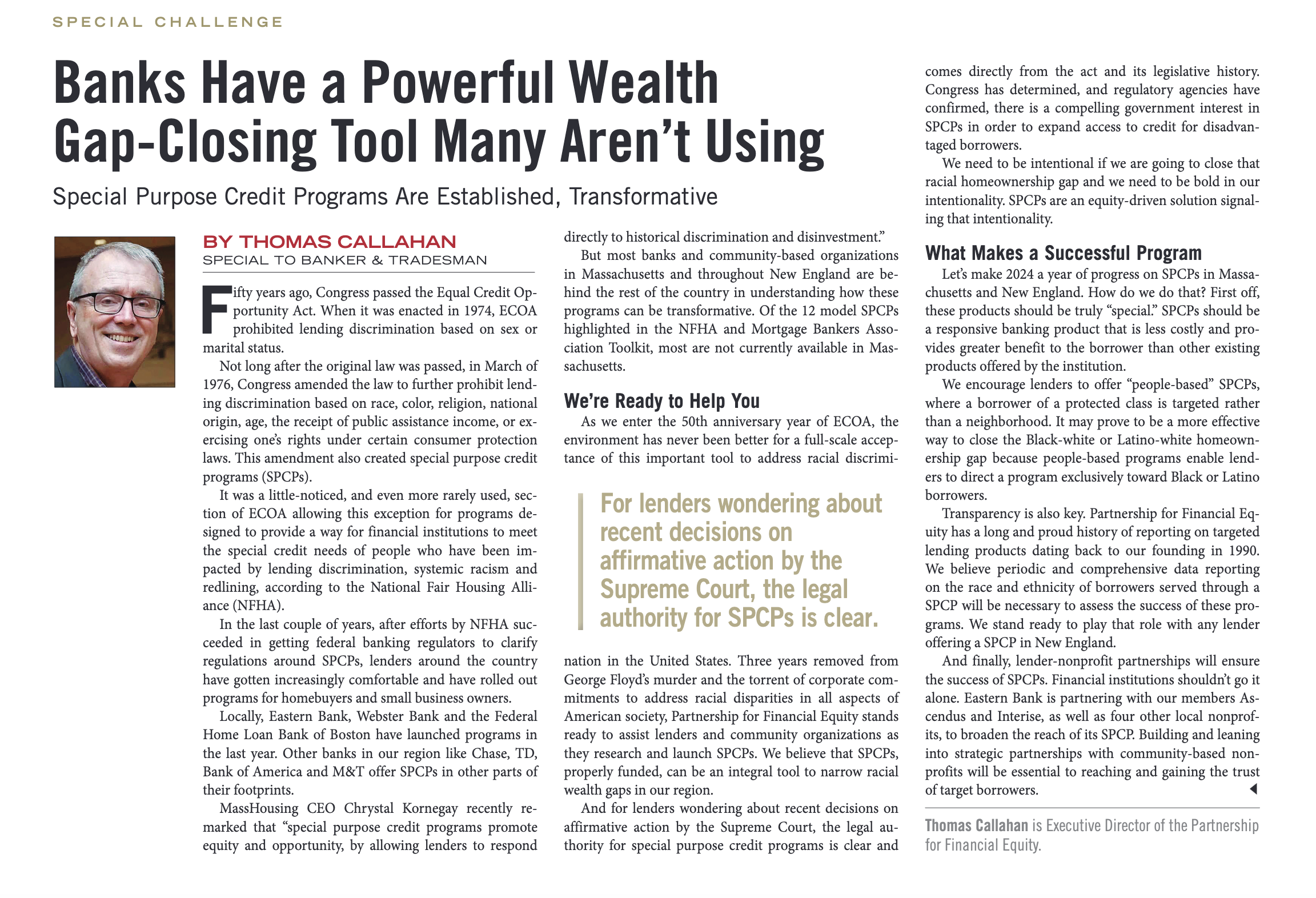
Banks Have a Powerful Tool Many Aren’t Using

Special Purpose Credit Programs Are Established, Transformative, Can Close Wealth Gap

From Banker & Tradesman January 8, 2024

Fifty years ago, Congress passed the Equal Credit Opportunity Act. When it was enacted in 1974, ECOA prohibited lending discrimination based on sex or marital status.

Not long after the original law was passed, in March of 1976, Congress amended the law to further prohibit lending discrimination based on race, color, religion, national origin, age, the receipt of public assistance income, or exercising one’s rights under certain consumer protection laws. This amendment also created special purpose credit programs (SPCPs).

It was a little-noticed, and even more rarely used, section of ECOA allowing this exception for programs designed to provide a way for financial institutions to meet the special credit needs of people who have been impacted by lending discrimination, systemic racism and redlining, according to the National Fair Housing Alliance (NFHA).

In the last couple of years, after efforts by the NFHA succeeded in getting federal banking regulators to clarify regulations around SPCPs, lenders around the country have gotten increasingly comfortable and have rolled out programs for homebuyers and small business owners.

Locally, Eastern Bank, Webster Bank and the Federal Home Loan Bank of Boston have launched programs in the last year. Other banks in our region like Chase, TD, Bank of America and M&T offer SPCPs in other parts of their footprints.

MassHousing CEO Chrystal Kornegay recently remarked that “special purpose credit programs promote equity and opportunity, by allowing lenders to respond directly to historical discrimination and disinvestment.”

But most banks and community-based organizations in Massachusetts and throughout New England are behind the rest of the country in understanding how these programs can be transformative. Of the 12 model SPCPs highlighted in the NFHA and Mortgage Bankers Association Toolkit, most are not currently available in Massachusetts.

We’re Ready to Help You

As we enter the 50th anniversary year of ECOA, the environment has never been better for a full-scale acceptance of this important tool to address racial discrimination in the United States. Three years removed from George Floyd’s murder and the torrent of corporate commitments to address racial disparities in all aspects of American society, Partnership for Financial Equity stands ready to assist lenders and community organizations as they research and launch SPCPs. We believe that SPCPs, properly funded, can be an integral tool to narrow racial wealth gaps in our region.

And for lenders wondering about recent decisions on affirmative action by the Supreme Court, the legal authority for special purpose credit programs is clear and comes directly from the act and its legislative history. Congress has determined, and regulatory agencies have confirmed, there is a compelling government interest in SPCPs in order to expand access to credit for disadvantaged borrowers.

We need to be intentional if we are going to close that racial homeownership gap and we need to be bold in our intentionality. SPCPs are an equity-driven solution signaling that intentionality.

What Makes a Successful Program

Let’s make 2024 a year of progress on SPCPs in Massachusetts and New England. How do we do that? First off, these products should be truly “special.” SPCPs should be a responsive banking product that is less costly and provides greater benefit to the borrower than other existing products offered by the institution.

We encourage lenders to offer “people-based” SPCPs, where a borrower of a protected class is targeted rather than a neighborhood. It may prove to be a more effective way to close the Black-white or Latino-white homeownership gap because people-based programs enable lenders to direct a program exclusively toward Black or Latino borrowers.

Transparency is also key. Partnership for Financial Equity has a long and proud history of reporting on targeted lending products dating back to our founding in 1990. We believe periodic and comprehensive data reporting on the race and ethnicity of borrowers served through a SPCP will be necessary to assess the success of these programs. We stand ready to play that role with any lender offering a SPCP in New England.

And finally, lender-nonprofit partnerships will ensure the success of SPCPs. Financial institutions shouldn’t go it alone. Eastern Bank is partnering with our members Ascendus and Interise, as well as four other local nonprofits, to broaden the reach of its SPCP. Building and leaning into strategic partnerships with community-based nonprofits will be essential to reaching and gaining the trust of target borrowers.

Thomas Callahan is Executive Director of the Partnership for Financial Equity.

Don’t be fooled

Today’s Boston Globe has an op-ed from the CEO of the Greater Boston Real Estate Board (GBREB) on how to make housing more affordable in Massachusetts. Excuse me while I choke on my Cherrios.

This the same real estate lobby that opposed virtually every new initiative designed to increase the amount of affordable housing over the last forty years. Real estate interests opposed Boston’s efforts to initiate a linkage fee for affordable housing in 1983 under Mayor Flynn and testified earlier this year against Mayor Wu’s proposal to increase linkage. They funded the campaign to repeal rent control in 1994. They fought Mayor Menino’s efforts to implement the city’s first inclusionary development policy in 2000. They opposed efforts to win approval of the Community Preservation Act in Boston in 2001 and earlier fought off attempts to fund CPA with a statewide or local-option transfer tax. GBREB threatened a campaign to defeat the CPA in Boston again in 2016 but backed down when they saw the broad political and grassroots coalition that had formed to pass it. As recently as 2019, they were lobbying at the State House against increases in the state match for CPA.

So, what is going on here? The piece makes some good points endorsing Governor Healey-backed proposals to ease restrictions on accessory dwelling units, building affordable housing on state-owned land and encouraging CPA communities to spend more than the 10% minimum threshold on housing.

What is not mentioned in the op-ed is the real headline. Re-establishment of local-option rent control as proposed by Boston and Somerville is not mentioned. Nor is passage of another Healey priority – giving communities the right to assess a tax on high-end real estate sales in order to raise more funds for affordable housing. GBREB is trying to look like they are on offense in the affordable housing battle but they are just, once again, playing defense and protecting the narrow interests of a select few in the real estate industry. GBREB is playing its version of the NIMBY card. NIMBLY. Not In My Bottom Line Yardstick.

The problem with solving our affordable housing crisis isn’t endorsing the easy items, like building on state-owned land. We have to do the tough stuff too. And that requires everyone, communities like Milton and the Greater Boston Real Estate Board, to get beyond just saying no.