Banks Have a Powerful Tool Many Aren’t Using

Special Purpose Credit Programs Are Established, Transformative, Can Close Wealth Gap

From Banker & Tradesman January 8, 2024

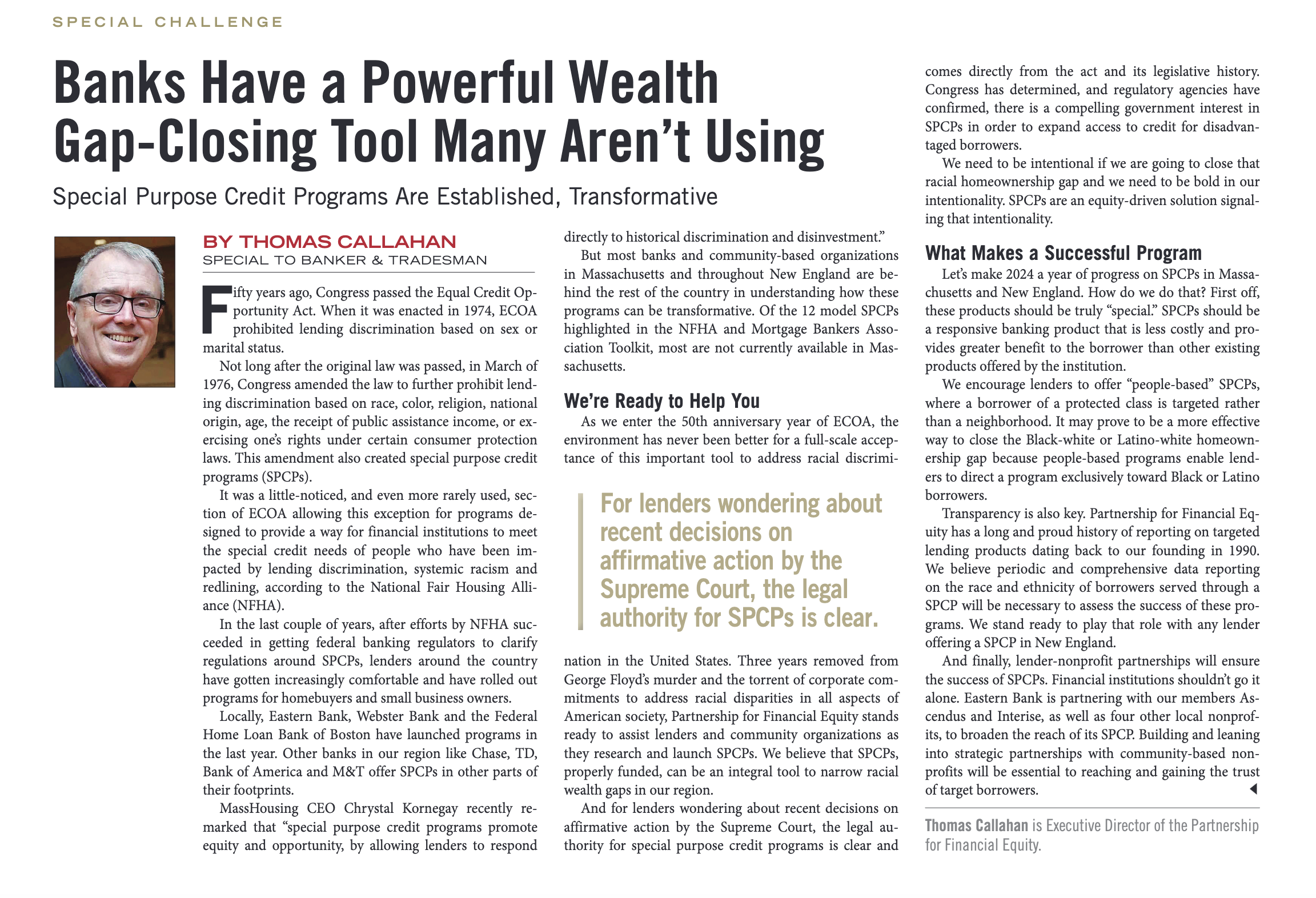
Fifty years ago, Congress passed the Equal Credit Opportunity Act. When it was enacted in 1974, ECOA prohibited lending discrimination based on sex or marital status.

Not long after the original law was passed, in March of 1976, Congress amended the law to further prohibit lending discrimination based on race, color, religion, national origin, age, the receipt of public assistance income, or exercising one’s rights under certain consumer protection laws. This amendment also created special purpose credit programs (SPCPs).

It was a little-noticed, and even more rarely used, section of ECOA allowing this exception for programs designed to provide a way for financial institutions to meet the special credit needs of people who have been impacted by lending discrimination, systemic racism and redlining, according to the National Fair Housing Alliance (NFHA).

In the last couple of years, after efforts by the NFHA succeeded in getting federal banking regulators to clarify regulations around SPCPs, lenders around the country have gotten increasingly comfortable and have rolled out programs for homebuyers and small business owners.

Locally, Eastern Bank, Webster Bank and the Federal Home Loan Bank of Boston have launched programs in the last year. Other banks in our region like Chase, TD, Bank of America and M&T offer SPCPs in other parts of their footprints.

MassHousing CEO Chrystal Kornegay recently remarked that “special purpose credit programs promote equity and opportunity, by allowing lenders to respond directly to historical discrimination and disinvestment.”

But most banks and community-based organizations in Massachusetts and throughout New England are behind the rest of the country in understanding how these programs can be transformative. Of the 12 model SPCPs highlighted in the NFHA and Mortgage Bankers Association Toolkit, most are not currently available in Massachusetts.

We’re Ready to Help You

As we enter the 50th anniversary year of ECOA, the environment has never been better for a full-scale acceptance of this important tool to address racial discrimination in the United States. Three years removed from George Floyd’s murder and the torrent of corporate commitments to address racial disparities in all aspects of American society, Partnership for Financial Equity stands ready to assist lenders and community organizations as they research and launch SPCPs. We believe that SPCPs, properly funded, can be an integral tool to narrow racial wealth gaps in our region.

And for lenders wondering about recent decisions on affirmative action by the Supreme Court, the legal authority for special purpose credit programs is clear and comes directly from the act and its legislative history. Congress has determined, and regulatory agencies have confirmed, there is a compelling government interest in SPCPs in order to expand access to credit for disadvantaged borrowers.

We need to be intentional if we are going to close that racial homeownership gap and we need to be bold in our intentionality. SPCPs are an equity-driven solution signaling that intentionality.

What Makes a Successful Program

Let’s make 2024 a year of progress on SPCPs in Massachusetts and New England. How do we do that? First off, these products should be truly “special.” SPCPs should be a responsive banking product that is less costly and provides greater benefit to the borrower than other existing products offered by the institution.

We encourage lenders to offer “people-based” SPCPs, where a borrower of a protected class is targeted rather than a neighborhood. It may prove to be a more effective way to close the Black-white or Latino-white homeownership gap because people-based programs enable lenders to direct a program exclusively toward Black or Latino borrowers.

Transparency is also key. Partnership for Financial Equity has a long and proud history of reporting on targeted lending products dating back to our founding in 1990. We believe periodic and comprehensive data reporting on the race and ethnicity of borrowers served through a SPCP will be necessary to assess the success of these programs. We stand ready to play that role with any lender offering a SPCP in New England.

And finally, lender-nonprofit partnerships will ensure the success of SPCPs. Financial institutions shouldn’t go it alone. Eastern Bank is partnering with our members Ascendus and Interise, as well as four other local nonprofits, to broaden the reach of its SPCP. Building and leaning into strategic partnerships with community-based nonprofits will be essential to reaching and gaining the trust of target borrowers.

Thomas Callahan is Executive Director of the Partnership for Financial Equity.
Don’t be fooled

Today’s Boston Globe has an op-ed from the CEO of the Greater Boston Real Estate Board (GBREB) on how to make housing more affordable in Massachusetts. Excuse me while I choke on my Cherrios.

This the same real estate lobby that opposed virtually every new initiative designed to increase the amount of affordable housing over the last forty years. Real estate interests opposed Boston’s efforts to initiate a linkage fee for affordable housing in 1983 under Mayor Flynn and testified earlier this year against Mayor Wu’s proposal to increase linkage. They funded the campaign to repeal rent control in 1994. They fought Mayor Menino’s efforts to implement the city’s first inclusionary development policy in 2000. They opposed efforts to win approval of the Community Preservation Act in Boston in 2001 and earlier fought off attempts to fund CPA with a statewide or local-option transfer tax. GBREB threatened a campaign to defeat the CPA in Boston again in 2016 but backed down when they saw the broad political and grassroots coalition that had formed to pass it. As recently as 2019, they were lobbying at the State House against increases in the state match for CPA.

So, what is going on here? The piece makes some good points endorsing Governor Healey-backed proposals to ease restrictions on accessory dwelling units, building affordable housing on state-owned land and encouraging CPA communities to spend more than the 10% minimum threshold on housing.

What is not mentioned in the op-ed is the real headline. Re-establishment of local-option rent control as proposed by Boston and Somerville is not mentioned. Nor is passage of another Healey priority – giving communities the right to assess a tax on high-end real estate sales in order to raise more funds for affordable housing. GBREB is trying to look like they are on offense in the affordable housing battle but they are just, once again, playing defense and protecting the narrow interests of a select few in the real estate industry. GBREB is playing its version of the NIMBY card. NIMBLY. Not In My Bottom Line Yardstick.

The problem with solving our affordable housing crisis isn’t endorsing the easy items, like building on state-owned land. We have to do the tough stuff too. And that requires everyone, communities like Milton and the Greater Boston Real Estate Board, to get beyond just saying no.

“There’s just no room.”

Milton resident Brian O’Halloran uttered those words just four days before Christmas, apparently unironically. No room at the inn here in our town, I guess.

“It’s impossible for us to understand how adding half of those 2,461 units, how that’s going to be accomplished,” stated O’Halloran in a Dec 21 interview with WBZ-TV News. O’Halloran was speaking in a town that has grown by 4 percent since 1970, surrounded by a region that has grown by over 20 percent during the same time period. Either the 68 year old software engineer is being disingenuous or he is suffering from a complete lack of imagination of how growth can and does happen in the eleventh largest metropolitan region in the US.

The NIMBYs have roared back. Confronted with losing the vote (by a two-thirds majority) to adopt compliant MBTA Communities Act zoning at town meeting on December 11th, they invoked a little-used section of the town charter and collected signatures of five percent of Milton voters in seven days to force a town-wide referendum in late January or early February. It was an impressive show of organization and passion to obtain the requisite number of signatures in the busy holiday season.

We have, of course, responded as well. Our Yes for Milton ballot question campaign committee filed with the town clerk on December 20th, one day before the WBZ interview. We are developing our plan to make our case to Milton voters over the next month. A 30 page zoning amendment that has been debated for over 18 months will now be decided by campaign slogans on each side. Yes for Milton or Just Say No. Stay tuned.

When NIMBYs don’t have numbers

When you give a mouse a cookie, he’ll ask for a glass of milk.

When you outnumber NIMBYs at a town meeting, they ask to delay, dissemble and distract.

“We are not a rapid-transit community,” they cried. “We need more time,” said the Planning Board member who has done nothing in 18 months to move toward compliance.

“How would you like living across the street from a five story apartment building,” said the man who looks across at a huge unsightly salt pile currently. “I was elected to represent Milton residents,” said the public official who assumed that everyone in town would agree he should act to make it harder for people to become his neighbor.

And my favorite one of all. “There’s not enough affordable housing in this zoning article,” exclaimed several town residents who have been on the wrong side of affordable housing efforts in Milton for twenty years.

Last night, Milton joined Brookline, Newton, Arlington, Lexington and others in passing a compliant zoning article in advance of the MBTA Communities Act deadline. It was the first town-wide rezoning effort in Milton since 1938 when towns around the country started to enact zoning ordinances to keep the “other” out.

As Richard Rothstein in The Color of Law chronicled, segregation in America is the byproduct of explicit government policies at the local, state, and federal levels, often with zoning bylaws leading the way.

Zoning is a choice. We have allowed homeowners, often disproportionately white and older as documented in groundbreaking research by Boston University professors Katherine Levine Einstein and Maxwell Palmer, to determine who they have as neighbors. It is seen as normal that homeowners can keep tenants and lower income prospective homebuyers out. Why have we allowed that for so long?

We have lived in Milton for 29 years. A really good 29 years. Our careers flourished here. Our kids grew up here. And we met our neighbors. And began organizing. And met more neighbors who wondered why we couldn’t have amenities like increased housing choices, more small businesses, more neighbors and more walk-to neighborhoods. This campaign for multi-family zoning wasn’t possible when we first moved to town. But it is now because NIMBYs have exposed themselves in front of town meeting, planning board forums, and Facebook group chats.

They have no answers. Just no. During the campaign, a flyer from the NIMBY group, Milton Neighbors for Responsible Zoning, was mailed to town meeting members. At the bottom it said,

We’re not saying NO,
We’re not saying NEVER,
We’re just saying NOT NOW!

Putting aside the bold type and all caps style, they are saying no with their action, or rather, inaction. The four person majority on the planning board spent 18 months “studying” the issue and got no closer to drafting a compliant zoning article than they were at the start. They had no intention of complying. They did what Milton had become famous for in statewide housing circles. They appealed for special treatment. They delayed in the hope that the political reality would change. That worked for a long time.

This time there was no developer who threw up their hands at the delay tactics and moved on to another site in another town. There was no generous donor who could scoop up property and “protect” Milton. Political winds had shifted and Milton was expected to act as a responsible member of the greater Boston community.

NIMBYs will always try again. A local NIMBY activist was quoted in the Boston Globe promising a town-wide repeal effort. We will meet them at every turn and appeal to our neighbors to move Milton forward.

Most Milton residents, indeed most residents anywhere, do not want to break the law. A campaign that asks them to do so has an uphill battle. There is not a modern-day Rosa Parks leading this civil disobedience effort. No moral high ground. Just a bunch of aging white homeowners willing to lie about the law and its impacts.

And an organized group of neighbors willing to stand up and be counted. Affordable Inclusive Milton stood tall with neighbors from every precinct: Republican lawyers, young renters looking to buy in Milton, parents who worry that their kids will never be able to afford to move back, social justice advocates, environmentalists, older residents that remember when Milton’s housing stock wasn’t so expensive. It was a large and diverse coalition that countered the NIMBYs. Milton for everyone. It’s such a better slogan than “not now!”

Smile no more

Amazon announced in an email to customers yesterday that they will be ending the program that allows shoppers to direct 1/2 of 1% of purchases to the nonprofit of their choice.

At first glance, Amazon Smile has impressive stats. It has resulted in nearly $450 million in donations since it began in 2013. Media accounts yesterday featured quotes from small nonprofit leaders, often volunteer-led, that will be hurt by this decision.

But according to reports, the average donation per nonprofit in the United States was just $230 in 2022. One million organizations around the globe were eligible to receive donations from Amazon Smile.

Good riddance, Amazon Smile. It was, at its core, a gimmick by Amazon designed to lure more shoppers and make them feel better about eschewing local small businesses. The percentage donated and opaque manner of determining whether or not consumers were using the separate Smile website was always designed for minimal impact.

Amazon has announced that it will instead refocus on bigger investments in areas such as affordable housing, computer science education and disaster relief. But no details were offered about this commitment.

Amazon has a chance to make this a win for both its customers and itself. Amazon has some experience in the affordable housing sector. Two years ago, Amazon announced a $2 billion Housing Equity Fund that will create or preserve 20,000 affordable homes in three headquarters regions—Arlington, VA; Puget Sound, WA; and Nashville, TN. Most of that commitment will come in the form of below-market loans. In addition, Amazon’s Housing Equity Fund is providing $125 million in cash grants to businesses, nonprofits, and minority-led organizations to help them build a more inclusive solution to the affordable housing crisis, which disproportionately affects communities of color.

Good stuff. Yesterday’s announcement about the demise of Smile means Amazon needs to step up again. Increase grantmaking to nonprofits leading the way with innovative solutions to the housing crisis. Increase the geographic reach of this giving to include other high-cost communities like Boston that desperately need more corporate investment to complement robust public sector efforts. Invest in communities of color and commit to closing to racial wealth gap.

As progressives we love to take shots at Amazon. It is such an easy target. But Amazon’s hand in transforming retail in the United States is not a short-term phenomenon. Like it or not, Amazon is here to stay. As the world’s leading retailer and sixth largest public company, Amazon has a responsibility to be a big part of transformational solutions to intractable problems that impact Amazon workers and their neighbors.

Jeff Bezos and senior Amazon executives are right to focus on housing affordability. They have seen the need up close in Seattle, a city Amazon has been part of gentrifying. Adding insult to injury, Amazon and others successful fought a tax in Seattle in 2018 that would have funded housing for the homeless. Five years later, they have a chance to repair the damage with a historic investment in solving the housing crisis in the United States. Will they?

Amazon strives to be “Earth’s most customer-centric company” according to its website. It customers in Boston, Seattle and elsewhere need housing help. Its customers are watching and waiting.

A preferential option for the poor

“A preferential option for the poor.” Dr. Paul Farmer took Gustavo Gutierrez’s writing on A Theology of Liberation and included it in a nonprofit mission statement. Farmer died yesterday in Rwanda at the age of 62. He was the co-founder of the global nonprofit Partners in Health working to improve health care in Haiti, Rwanda, Sierra Leone and other countries. He leaves an incredible legacy and a thriving organization that has made a real difference in countless lives.

It is hard to describe the emotions when someone you have never met dies and you feel strangely connected. That happened to me yesterday. There are some obvious reasons why I felt that connection. Both Paul Farmer and I were born in North Adams seventy days apart 62 years ago. We were both raised Catholic.

And the writings of Gutierrez shaped our careers. For me, it was a religion class at Fairfield University that introduced me to A Theology of Liberation just ten years after it was published. It was really the first time that my faith truly spoke to me. This is why I am a Catholic. This is my faith.

Gutierrez writes, “Christians have not done enough in this area of conversion to the neighbor, to social justice, to history. They have not perceived clearly enough yet that to know God is to do justice. They have yet to tread the path that will lead them to seek effectively the peace of the Lord in the heart of social struggle.”

Farmer acted on his faith. See. Judge. Act. Farmer talks about how this theological construct is similar to what physicians are supposed to do when they see a patient. His actions perfectly capture the power of example. “Don’t tell us you can’t treat AIDS in rural Haiti, we’re doing it,” says Farmer on the podcast Jesuitical last year. “One of the ways we move forward as Partners in Health is by sometimes being quiet and just doing the work. And being able to point to something and say look, ‘don’t say its impossible, don’t say its not feasible, not prudent and please don’t say it is not sustainable because none of us is sustainable.”

Despite all the despair and desperation Farmer observed over his career, he remained an optimist about global health and even about what the pandemic might do to attitudes in the United States. “People will have to sort out a narrative to explain our failures [during the pandemic]. And I’m hoping people will come to the conclusion that we aren’t doing things right. We need better safety nets. We need more investment in public health…I’m probably guilty of pathological optimism but I have conviction that we are going to make real progress.”

We will have to do it without him but not without his organization, Partners in Health. We will all have to do the work of acting to transform the social structures that contribute to suffering and injustice in the world by seeing, judging and acting as individuals and as part of a collective movement.

Which candidate for governor will make closing the racial homeownership gap a campaign centerpiece?

“One of the best and most effective ways you can build wealth is through homeownership, and the data has shown time and time again that people of color have not had the same access to federal programs that whites have had. We have an opportunity to do something about that. We should do it with [ARPA] funding. And we should do it now.”

That strong and specific statement was spoken by Republican Governor Charlie Baker who has made closing the racial homeownership gap a focus over the past year. While Baker is justifiably focused on the issue, it is noticeable that he hasn’t had as much success in getting Democrats to join him. A legislature dominated by Democrats reduced his proposed spending on his race-conscious homeownership strategies from $500 million to $180 million when they voted on the first round of American Rescue Plan Act spending.

Last year when Michelle Wu and Annissa Essaibi George battled in the Boston mayor’s race, both women talked a lot about closing the racial homeownership gap. They took notice of the thousands of voters who are flocking to first-time homebuyer classes in Boston and across the state. They endorsed specific solutions. They talked about this issue repeatedly and effectively.

What will our candidates for Governor do this year? Buying a home in Massachusetts has never been harder. Our statewide median home price has topped $500,000 behind just Hawaii and California but without the weather. Last week the Greater Boston Association of Realtors said the median price of a single-family home hit $750,000 in 64 cities and towns in eastern Massachusetts. Our wide and persistent racial gap is stubbornly large. Nearly 7 out of 10 white households own their own home in Massachusetts. Just 35 percent of Black, Latinx and Asian households are homeowners in our state.

So why aren’t we hearing more about this from our statewide candidates? Tens of thousands of homebuyers are desperate to buy a home in Massachusetts and finding it increasingly impossible. To be fair, Sonia Chang-Diaz and Danielle Allen have strong language on their websites endorsing closing “…the racial wealth gap and create more opportunities for lower- and middle-income families to build generational wealth through homeownership” [Chang-Diaz] and “…increase down payment assistance for first-time home-buyers, with prioritization on first-generation home-buyers” [Allen]. Maura Healey’s website is not yet built out with an issue section but her announcement video doesn’t mention housing at all.

Why isn’t housing in general and homeownership specifically more of a statewide issue? It could be that many of our statewide candidates play to the voter-rich suburban communities where 8 or 9 out of 10 households are already homeowners and benefit from ever increasing home values. It could be the paucity of representation of elected officials of color in the State House. People of color account for one-third of the residents in Massachusetts, but just 14% of House reps and 7.5% of state senators. It is undeniably a hard issue to solve with the need to build many more homes which will meet with not-in-my-backyard protestations and the necessary infusion of billions of dollars in new investment. Fixing health care or education or transportation is equally daunting, yet those issues seem to get more attention from our elected officials.

We should expect more in Massachusetts. We sit near the bottom of the pack in the United States with our wide racial homeownership gap. The gap will not close itself. In fact, given the inter-generational transfer of wealth that homeownership provides, the gap will get worse unless we take intentional action to close it. The kind of action and leadership that can be provided by a Governor. Or a candidate for Governor.

Easy and hard

30 years as executive director. 34 years at the same community-based organization. It comes to an end today.

MAHA is a wonderful place to create change, build a career, develop friendships. We’ve done “some good in this world” as Hermione Granger said. I was 27 when Lew Finfer hired me. It was my third job in five years after the first two nonprofits where I worked fell on hard times financially. Back then it never occurred to me that I would be a few days away from 62 when I walked out the door at MAHA for the last time. Or that my two daughters would be born during my years at MAHA and would be full-grown adults before I changed employers.

In 1987, home prices were spiking for, perhaps, the first time in Boston history. Lew charged Hillary Pizer and me with the goal of developing a grassroots constituency for more affordable housing. After some research, the concept of an organization made up of would-be homebuyers was born. First-time homebuyers were being priced out of the city and the region. Eileen and I experienced that first-hand a year earlier when we struck out trying to buy a home in Dorchester and eventually discovered a more affordable homeownership option in Brockton.

We mailed to people who had applied to buy an affordable home in the city and asked them to call or mail us a return postcard indicating that they would be interested in organizing a group effort to do something about unaffordable home prices. Twenty percent of those we mailed to returned that card – an organizer’s dream. People were reaching out to us. We were on to something. We just didn’t know what exactly.

At the very first meeting, this nascent group of [largely] women of color taught us something else about trying to buy a home in Boston. “The banks won’t give us a mortgage,” they said.

“Why?” said this white guy.

“Because no one we know has ever gotten a loan from them. Let’s take on the banks!”

This was our first meeting. It would take another year but we got our chance. On January 11, 1989 the Boston Globe led with the headline INEQUITIES ARE CITED IN HUB MORTGAGES; Preliminary Fed finding is ‘racial bias’. By that summer, a coalition of six community organizations, including MAHA, presented the banks with a $1 billion community reinvestment plan. MAHA’s Homebuyers Union leaders demanded a more affordable mortgage that would help families of color and others afford to stay in Boston.

They won. We won. And ultimately the banks learned that they had won as well. That mortgage program still exists today thanks to MAHA’s organizing and with outstanding stewardship and so much more from the Massachusetts Housing Partnership. Today it has helped more than 23,600 homebuyers obtain their first home. Statewide, over 60% of those buyers are households of color and that number rises to 80% in Boston and the Gateway Cities. It has worked.

But what has really worked is that the women of color who showed up to that first meeting in a Dorchester church in 1989 have motivated and nurtured successive generations to keep fighting for change. Diana Strother and Adrianne Anderson gave way to Florence Hagins who inspired current activists like Cortina Vann and Acia Adams-Heath. Cortina, Acia and others helped Esther Dupie and Symone Crawford find a home at MAHA. And now Symone will lead MAHA into the future with a young generation of soon-to-be activists signing up for classes in record numbers.

I cleaned my office yesterday and it was both easy and hard. Easy because I was alone in a quiet office on a rainy day ready to close a chapter, albeit a long one. Hard because every report, news clip, or photo brought a flood of memories of campaigns and long nights and wins and losses, both professional and personal.

Easy and hard. Easy to spend 34 years at a place where everyone is on the same team fighting for justice and pulling for each other. Those relationships have enriched me like I could never have imagined. Hard to do this work because there is so much more to do. Our 23,600 homebuyers haven’t closed the racial homeownership gap in Massachusetts. We have to be bolder and more intentional as an organization and as a Commonwealth if we are to succeed.

Thank you to all of my current and former co-workers, colleagues, friends and family who have supported me over the years. You are too numerous to mention here but know that your wisdom and guidance has been invaluable to me. Thank you and undying love to Eileen, Brenna and Devan who have been my support system and inspiration for 40, 28 and 25 years respectively.

This is not retirement. Much work remains. A new chapter will unfold. MAHA is in great hands. As Marge Piercy wrote in The Low Road…

It goes on one at a time,
it starts when you care
to act, it starts when you do
it again after they said no,
it starts when you say We
and know who you mean, and each
day you mean one more.

Make a donation

https://mahahome.org/

Super reasons

After watching the Jaylen Brown-less Celtics fall to the Phoenix Suns this afternoon, I turned off the television. No big game for me this year just like the last three years. I’ve stopped watching the NFL .

It really hasn’t been that hard of a transition. Sunday afternoons in the fall at the supermarket were a revelation. Hikes in the woods felt better than watching the Patriots. It is just this Sunday every year that feels different. When you know that fans, casual fans, and many non-fans are watching this cultural moment across the country. I will follow the commentary on the advertisements on social media and observe whether Tom Brady can win a seventh Super Bowl but I will not watch the NFL.

Like many decisions, this one was influenced by several factors. When I made this decision in 2017, my home team was owned, coached and quarterbacked by men who seemed preternaturally inclined to suck up to Donald Trump. I don’t pretend to know who Kraft, Belichick and Brady voted for but given Trump’s racism and corruption, their unwillingness to distance themselves from him was repugnant.

During the 2016 and 2017 seasons, the NFL showed its true colors with its reaction to Colin Kaepernick and his kneeling protest for racial justice and reform of policing in the United States. One need to look no further than the NBA for a league that took a decidedly different stance in support of players commenting on matters of race and justice.

And finally, the brutal nature of the game got to me after all of these years. In 2015, the movie Concussion came out and made the issue of chronic traumatic encephalopathy, or C.T.E. hard to ignore any longer. Repeated blows to the head, similar to what occurs regularly on a NFL field, cause C.T.E. “It’s like smoking and cancer,” said Bruce Miller, a neurologist and Alzheimer’s expert at the University of California, San Francisco, . “It’s as clear as day.” As a fan, it increasingly bothered me that each team had to prepare for season-ending injuries to key positions every single year because it was impossible to get through a year without significant losses. Attending a game almost felt like being a Roman at the Colosseum. Now the evidence was in. C.T.E. is shortening lives and making the quality of those lives significantly worse.

So I won’t be watching. I have resisted disclosing this because most of the people I know – family, friends, colleagues – will be watching. Heck, much of the country will be watching. I’m not claiming any moral superiority here. It helps that my dad was not much of a NFL fan and I began truly following the Patriots only after graduating from college. No judgements here. Football at its best showcases incredible athletes doing amazing feats on the field. Malcolm Butler’s goal line interception is still seared into my brain as is David Tyree’s unbelievable balancing of a football on top of his helmet.

Football is part of the United States for both good and ill. NFL ratings remain fairly stable, rising and falling slightly over the last four years through all sorts of controversy. It is not lost on me that the largest group of people who report they have stopped watching in recent years includes white men who were turned off because of the players kneeling in protest. Black men peacefully protesting is evidently a bridge too far for some. I’ll root for an NFL that respects its players’ health and welfare and freedom of speech. And, in the meantime, I’ll follow Jaylen Brown on and off the court.

Pandemic, politics and pickleball

Mid-March brought new rules and a new way of life. Work suddenly transitioned to home and masks, hand-washing, and social distancing became the new norm.

In our neighborhood, the pandemic brought something else. Pickleball. Our nearby tennis courts were transformed into pickleball courts by senior citizens heretofore not seen in these parts. Where were they from? And what is pickleball?

Each morning a small brigade of seniors descended on the courts. They set up a special pickleball net and lawn chairs and games would soon break out. Thwap. The sound of the whiffle ball hitting the paddle would echo through the neighborhood. It felt like Florida had come north.

Was this a trend? Were thousands of Floridians moving back north? Where would they vote this fall if the pandemic continued? Getting Trump out of office was certainly the number one goal for 2020 and this pickleball surprise was yet another curveball in a political season like no other.

I debated conducting a poll of the pickleballers in my neighborhood. Who were they voting for and where were they voting? We could absorb Trump voters in Massachusetts given the expected huge margin for Democrats here. But with the momentum building for mail-in balloting, they just as easily could vote in Florida.

A 2018 Politico article had me spiraling. Speaking of the central Florida retirement community called The Villages, the reporter called it “…the pickleball capital of America, appropriate considering that the badminton-meets-tennis-ish paddle game has become America’s fastest-growing sport.” And I read further that these pickleball playing Villagers were twice as likely to be registered Republicans. And now they were in Milton. What else did 2020 have in store for us?

But as we entered month eight of this lockdown (that is not, in any way, a lockdown when people can still go to Target), things were looking up. Joe Biden and Kamala Harris won in a “landslide” to quote Donald Trump from 2016. Milton passed the Community Preservation Act with 62% of voters approving the question, presumably some pickleball players among them seeking dedicated courts in town.

Vaccine developments from Pfizer, Moderna and Astra Zeneca seemed to promise a better second half of 2021. And on the day before Thanksgiving, we received a delivery of a beautiful new refrigerator after a wait of four months due to backlogged factories from China to the United States. We also took our first Covid test and received negative results on Thanksgiving eve as well.

Adults will soon be in charge in DC. Georgia and Arizona are blue. There are so many important issues to address and one suspects that Mitch McConnell will be as obstructionist as always. But organizing and pressure will continue. We need support for our restaurants and small businesses that won’t be able to survive a long winter while Covid-19 deaths continue to rage. We need income supports for Americans who have lost jobs during the pandemic. We need a health care system that doesn’t induce worry of how to pay for my care among too many Americans. We need to stop evictions and foreclosures and make home truly safe for millions on the edge. We need a CDC that doesn’t mislead the public based on intimidation from the President. We need science to dictate the rollout of the vaccines. As many experts have said, vaccines don’t get us out of this, vaccinations will.

That’s why trust in government and our political leadership is all important. Competence matters. If next Thanksgiving is going to be a time for large gatherings again, we need everyone to get vaccinated. Vaccines can’t become the next mask debate where it is possible to reasonably predict how someone voted by whether or not they are wearing a mask. Trump gave us that and we can’t afford to have half of the country refuse to get vaccinated. Our lives depend on it.