A break, of sorts, from housing politics (although more coming on that soon). I learned this morning from Milton Historical Commission members Meredith Hall and Steve O’Donnell that the town of Milton became part of the first municipal effort in the United States to offer free vaccination to residents as part of the early efforts to eradicate smallpox. This excellent article on the website of the National Museum of American History details the role of Milton and its residents.

“Over three hundred persons were inoculated during a three-day campaign in July. Following this program, the town leaders took an unusual step—they decided to hold a public demonstration to prove without a doubt that cowpox vaccine offered protection from smallpox. On October 9, 1809, twelve children, selected from those vaccinated in July, were inoculated with fresh, virulent smallpox matter by Dr. Amos Holbrook and witnessed by eighteen town members. The children were confined to a single home for fifteen days and on October 25 were discharged with no sign of smallpox infection.”
“In 1810 the State of Massachusetts passed the Cow Pox Act directing every town, district, or plantation, within the Commonwealth, to provide for the vaccination of their inhabitants. The world is now free of small pox—a remarkable global achievement that owes a small debt to the citizens in a little town in New England in the early years of our republic.”
Why were we talking about smallpox this morning? It came up on a site walk organized by the Town Farm review committee charged with making a recommendation for the future use of the historic poor farm deeded to the town in 1701 by Royal Governor William Stoughton. We walked past the 1888 “pest house” which was used to quarantine people with infectious diseases. Pest houses were alternately called plague houses, fever sheds, or pestilence houses.
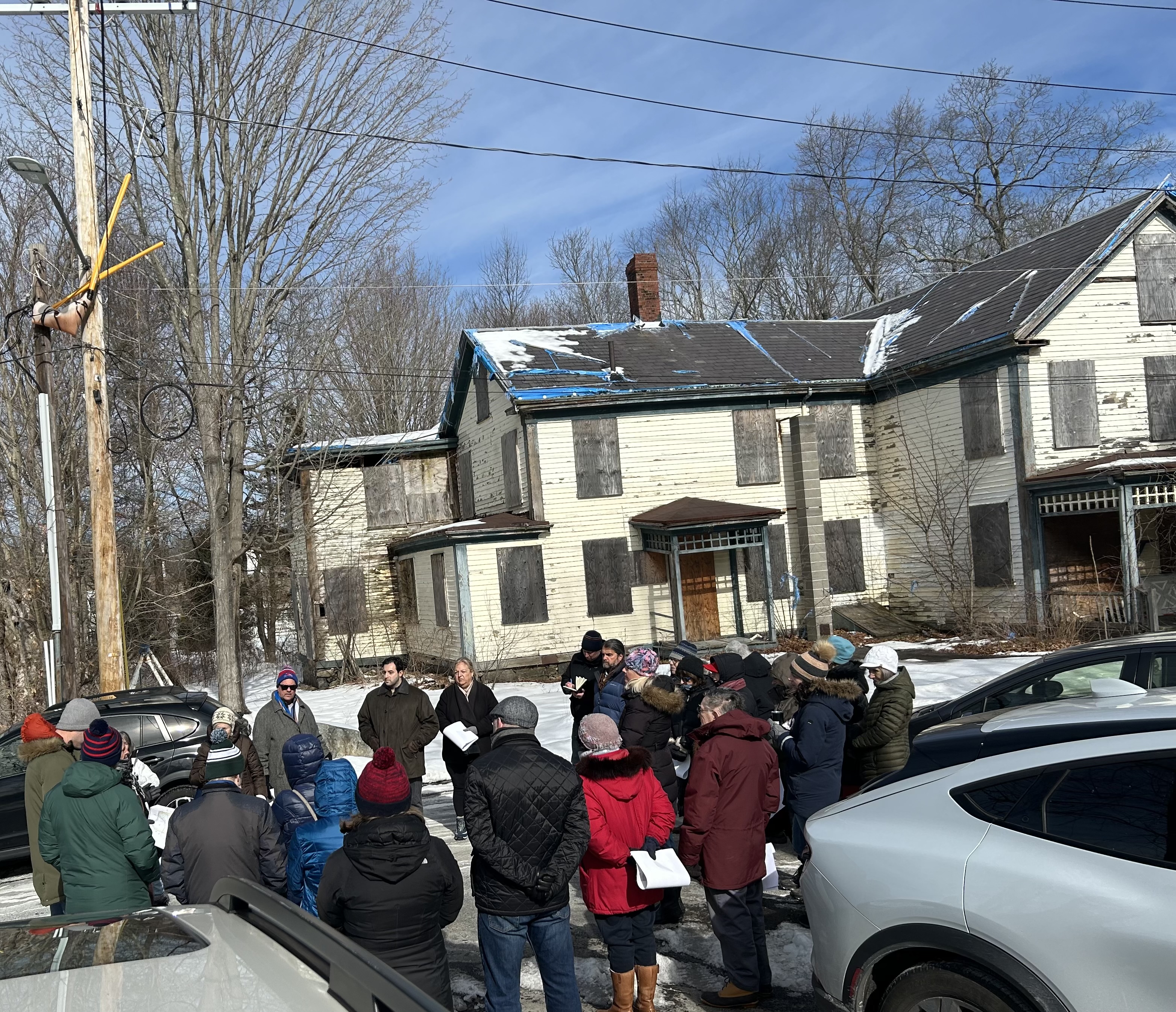
About twenty-five Milton residents braved the cold temperatures this morning to learn more about the site and its history of providing housing for the town’s poor. Three structures from the 19th century – the main almshouse, men’s almshouse along with the pest house – still remain although in very bad condition. Two developers have responded to the town’s Request for Proposals with plans to build 35 units of affordable housing on the site respecting the historic nature of the site. I did say a break, of sorts!
 Impolite Company