Send it back

Two nights of town meeting and two nights of dysfunction. Milton has been renamed Dysfunction Junction (with several rapid transit stations naturally!).

Last night, we sent two articles back to the Planning Board for more work including one on Accessory Dwelling Units. State law mandates ADUs in single-family districts now but towns can place “reasonable” restrictions on them. Town meeting determined that the article before us was not reasonable, including requiring more of those who wish to add a 900 square foot ADU than those wanting to build a 5,000 square foot McMansion. It was sent back for more work.

A site plan review article was sent back to the Planning Board. Two other articles were sent back to the Select Board. Town meeting members sent back 4 of 13 articles that were initiated by town bodies.

We did close town meeting with a bang however. Debate on Articles 14 and 15 came late, going until 11:15pm. Article 14 was a citizens petition to transfer $24.61 (a penny for every zoned unit called for by the MBTA CA) from the town’s legal budget to the schools. A symbolic shot across the bow of a town that is paying lawyers $940 per hour to defend us against the Attorney General. Article 15 was a non-binding citizens petition signed by over 200 residents that asked for the Planning Board to do its job and comply with the MBTA Communities Act.
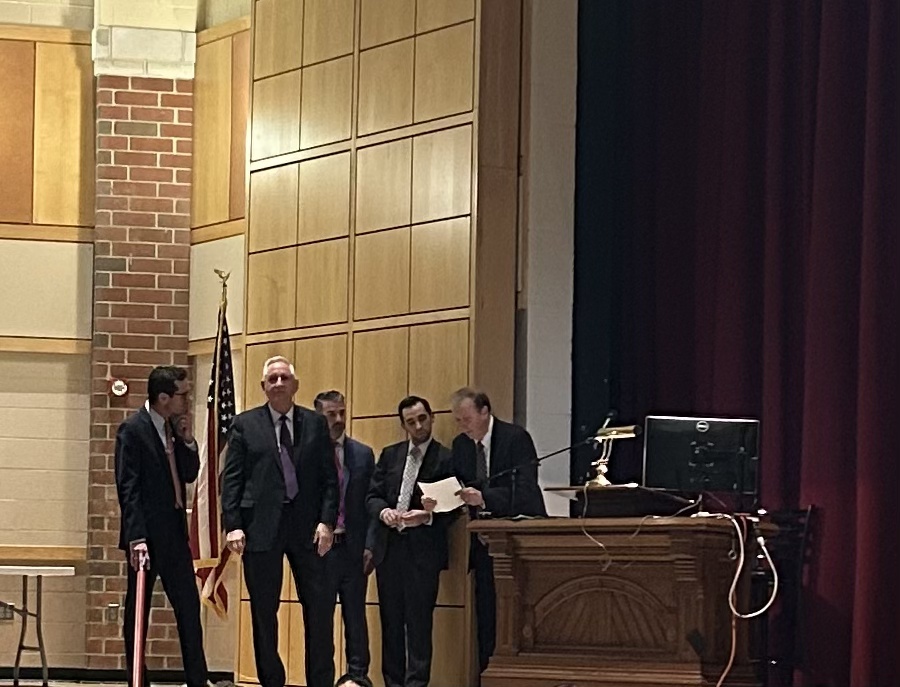
The debate was fiery. Sad. Disquieting. Three leaders of the “no” campaign took to the floor to double-down. The loss for the town in the Supreme Judicial Court was actually a win. Their greatest hits were played again. The no side really does want more affordable housing. The yes side doesn’t listen. Rapid transit is not rapid enough. It was angry, rambling and at times unhinged. Our moderator interrupted a town meeting member and reminded him to “not cast aspersions” but relented when the speaker told him he was casting aspersions on state government. That’s okay I guess. A heckler saying the “whole game is rigged” in a Trump-like rant from the cheap seats. The lead “no” organizer doing a commercial for her political operation. And the advertising executive turned affordable housing expert railing away and lying to the body by saying, three times for effect, “there is no provision for affordable housing in the MBTA Communities Act.” There is.

Not a great night. One hopeful sign was the overwhelming support for our public schools over the two nights. Both articles addressing our school overcrowding passed with huge majorities. We will need that unity this spring as Milton will vote on an override to stave off job cuts for our teachers and public safety personnel. Our divide on housing is real and deep. Our next test is to come together in support of a yes for our schools and town government services amidst the national anti-government environment. Godspeed, Milton.

Milton and smallpox

A break, of sorts, from housing politics (although more coming on that soon). I learned this morning from Milton Historical Commission members Meredith Hall and Steve O’Donnell that the town of Milton became part of the first municipal effort in the United States to offer free vaccination to residents as part of the early efforts to eradicate smallpox. This excellent article on the website of the National Museum of American History details the role of Milton and its residents.

“Over three hundred persons were inoculated during a three-day campaign in July. Following this program, the town leaders took an unusual step—they decided to hold a public demonstration to prove without a doubt that cowpox vaccine offered protection from smallpox. On October 9, 1809, twelve children, selected from those vaccinated in July, were inoculated with fresh, virulent smallpox matter by Dr. Amos Holbrook and witnessed by eighteen town members. The children were confined to a single home for fifteen days and on October 25 were discharged with no sign of smallpox infection.”

“In 1810 the State of Massachusetts passed the Cow Pox Act directing every town, district, or plantation, within the Commonwealth, to provide for the vaccination of their inhabitants. The world is now free of small pox—a remarkable global achievement that owes a small debt to the citizens in a little town in New England in the early years of our republic.”

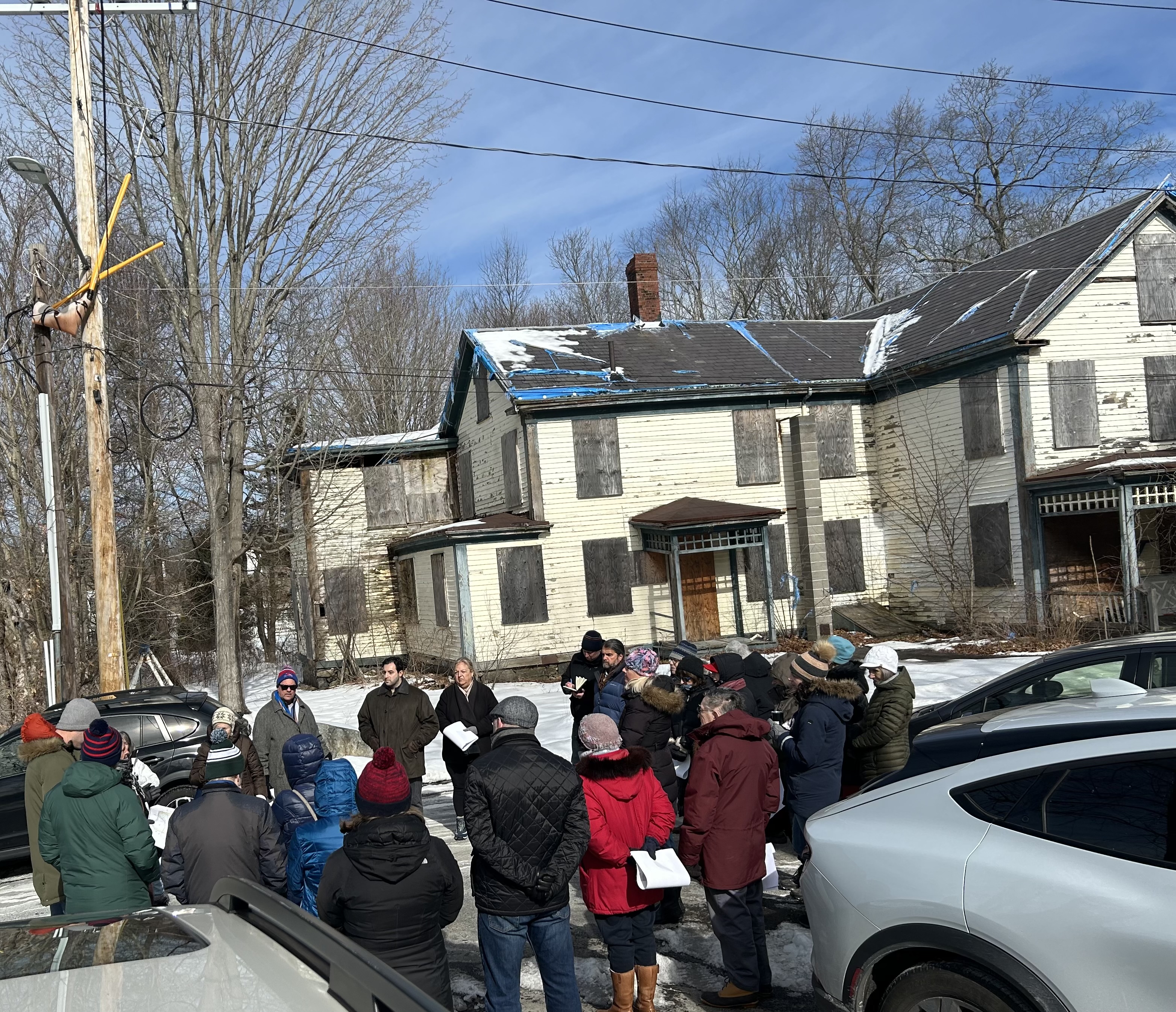
Why were we talking about smallpox this morning? It came up on a site walk organized by the Town Farm review committee charged with making a recommendation for the future use of the historic poor farm deeded to the town in 1701 by Royal Governor William Stoughton. We walked past the 1888 “pest house” which was used to quarantine people with infectious diseases. Pest houses were alternately called plague houses, fever sheds, or pestilence houses.

About twenty-five Milton residents braved the cold temperatures this morning to learn more about the site and its history of providing housing for the town’s poor. Three structures from the 19th century – the main almshouse, men’s almshouse along with the pest house – still remain although in very bad condition. Two developers have responded to the town’s Request for Proposals with plans to build 35 units of affordable housing on the site respecting the historic nature of the site. I did say a break, of sorts!

Tired

“I get up in the evenin’
And I ain’t got nothin’ to say
I come home in the mornin’
I go to bed feelin’ the same way
I ain’t nothin’ but tired
Man, I’m just tired and bored with myself…”
– Bruce Springsteen, Dancing in the Dark lyrics

Tired. Last night, Milton’s Select Board voted 3-2 (sound familiar?) to submit a tired letter to the state commenting on the new MBTA Communities Act regulations. Four years after its passage and after two full years of vigorous debate and opposition to this “massive state overreach”, our Select Board filed a letter taking exception to exactly one provision of this state law – our trolley is not rapid transit, they said.

The letter conveniently ignores that Chelsea, served by no subway lines but rather Silver Line dedicated bus route, is also considered rapid transit. The letter also cites the “abandonment” of a project in 1968 that would have extended the Ashmont branch to Mattapan using the trolley right-of-way and Red Line subway cars. That project was, of course, abandoned after vigorous protests from Milton residents.

Our current Select Board majority is “tired”, even “sick and tired”, of hearing about how we were “classist and racist”. We should stick to history and fact, they say.

Here are some facts and some history. 177 communities have been asked to comply with a 2021 upzoning mandate by the state with one of the worst housing affordability problems in the nation. 118 have submitted compliant zoning plans in good faith; 26 of 30 communities submitted action plans by February 13 stating an intention to comply with the revised state deadline of July 14, 2025 (the remaining small towns under 7,000 people have until Dec 31, 2025 to submit plans).

Four communities, Milton included, decided to remain in the increasingly lonely space of non-compliance. Defiantly non-compliant. And tired. Milton’s opposition is increasingly tired after each successive loss we endure. Losing at the game of “she won’t sue us”. Losing state grants. Losing legal fees. Losing at the state Supreme Judicial Court. And now losing with the vast majority of our peers who are complying with the law.

Milton has a long history suing the state. Milton vs. MBTA in 1968 tried to stop the replacement of the trolleys with subway cars. Milton residents at the time argued that there was “no apparent transportation benefit to the proposal” to replace the trolley with subway cars. Now, we argue that the trolleys are so inferior to other transit options that our zoning requirement should be slashed by 60% or even 80%. Our “unique” town is on an unenviable, and costly, losing streak. And that is tiring.

Less expensive lawyers and a lawless town

“At this time, the Town is unable [emphasis mine] to submit an Action Plan because the Town disagrees with the classification that Milton is placed in by the Executive Office of Housing and Livable
Communities (EOHLC).” – January 14, 2025 letter from Town of Milton to Executive Office of Housing and Livable Communities

Unable? Let’s try unwilling.

With a 3-2 vote, Milton decided to continue its lawbreaking ways on Friday. First, our Select Board missed the actual state-imposed deadline of February 13 to submit an action plan announcing the town’s intention to submit a compliant zoning plan before Town Meeting no later than July 14, 2025. Then, on Friday the 14th, they voted down the motion by Select Board members Erin Bradley and Ben Zoll to submit an action plan as required by the state.

Our advocates for “no” celebrated the one-year anniversary of the referendum vote to break the law with yet another vote to break the law. And virtually nothing offered by the no side has turned out to be true.

Advocates for no said the town wouldn’t get sued. We got sued by the Massachusetts Attorney General almost immediately.

Advocates for no said the AG couldn’t enforce compliance with the law. The decision in January 2025 by the Supreme Judicial Court said she could.

Advocates for no said the state couldn’t compel local zoning reforms. The January SJC decision determined the law was Constitutional.

Advocates for no said the trolley wasn’t rapid transit. The emergency regulations published in January 2025 make it crystal clear that the Mattapan High Speed Line, with its four stops in Milton, is rapid transit.

Advocates for no have been wrong on virtually everything. Their one victory, of sorts, was that the SJC ruled that the previous “guidelines” were not enforceable and that the state must go through a proper Administrative Procedures Act process to repromulgate enforceable “regulations”. Those paying attention, though, saw that the process used to develop the guidelines included extensive public comment and resulted in many changes to the original draft guidelines. To expect a different outcome now is really a stretch. In mid-April, Milton is likely to have final, enforceable, Constitutional regulations and be faced with yet another deadline – this one on July 14th.

Our no side still has no plan other than to continue to litigate, this time with “less expensive lawyers”, as one of the lead organizers of the no campaign said recently at a Select Board meeting. That always proves to be a winning strategy!

Select Board chair and State Rep. Richard Wells voting no on submitting an Action Plan

Voting no has dug a half-million dollar sized hole for the town between lost grants and legal fees, not to mention our well-earned laughing-stock reputation in the region. We are in that hole now and our elected officials can’t seem to stop digging. Will they stop? Or will voters have to stop them first?

ordo amoris

There is sooo much coming out of DC that it is impossible to keep up with and still maintain normal daily activities. But this one may have slipped past a lot of us. Musk and Trump are creating most of the chaos, acting illegally and betting that our court system can’t keep up. But third-wheel JD Vance has been making some news as well.

As many know, Vance converted to Catholicism as an adult in 2019. He was interviewed on Fox recently and invoked the concept of ordo amoris, Augustine’s ordering of loves. Terence Sweeney, a professor at Villanova University, does a much better job than I ever could explaining what Vance got wrong about ordo amoris. Below are excerpts from his column but I encourage you to read it in full in America Magazine.

Sweeney writes, “It is in this context that Vice President JD Vance introduced the idea of the ordo amoris, or ordering of loves, into this discourse. During a Fox News interview, he stated, ‘There is a Christian concept that you love your family and then you love your neighbor, and then you love your community, and then you love your fellow citizens, and then after that, prioritize the rest of the world.'” Vance goes on to say that the left has inverted this, “…they seem to hate the citizens of their own country and care more about people outside of their own borders…”

Sweeney concludes “What Mr. Vance gets wrong is that the point of Christian teaching is to expand, even transform, our order of loves.” Sweeney ends with “The ordo amoris was never about loving less or more narrowly—but about loving more and more widely.”

In Catholic circles, there has been widespread debate. I fall on the side of loving more and more widely. Vance’s comments taken with the actions of this administration to cut funding and programs for poor people near and far calls into question his commitment to ordo amoris, in any order.

Friday Night News Dump

News out of Milton tonight is that a local elected official has filed public comments on the MBTA Communities Act regulations. Ok, that elected official is me! What else would one do on a Friday night in between snow events?

As a Milton resident and elected town meeting member for the past twenty-five years, I write to offer the following comments on MBTA Communities Act regulations.

The updated definition of “Subway station” to include any of the stops along the MBTA Red Line, Green Line, Orange Line, or Blue Line, including but not limited to the Mattapan High Speed Line and any extensions to such lines is a welcome clarification. Our Mattapan trolley fits any reasonable definition of rapid transit because it runs on a frequent and regular schedule and operates on an exclusive right-of-way. Nevertheless, it has been the target of many opponents of this law, drawing much scorn and ridicule as a broken down relic.

Most of those critics in our town don’t ride the trolley. As an occasional rider on the Mattapan trolley, I am able to commute from Milton to downtown Boston in less time than it takes embarking from some of the stops on the Green Line. This dedicated transit line is a valuable resource to Milton residents (as well as Mattapan and Dorchester residents) and clearly qualifies as a subway station for the purposes of this law which is designed to create multi-family housing opportunities close to jobs and transit. The trolley is old and occasionally cranky but it is notable that the MBTA has clear plans to upgrade the trolleys and the line in the coming years. According to the MBTA’s website, over the next eight to 10 years, they will modernize stations and improve infrastructure throughout the Mattapan Line. This includes introducing the next generation of vehicles to the line, the Type 9 light rail vehicles used on the Green Line. Milton is a rapid transit community now and will remain one in the future and should be treated as such under these regulations.

The requirement that Milton and other rapid transit communities create a zoning plan allowing for Multi-family unit capacity equal to or greater than 25% of total housing units is reasonable, especially when you consider that build-out will take many decades and towns may never reach the upper limit of that zoning capacity. Milton must do its part to create housing opportunities in a state where it is increasing hard to afford rents or home prices. Housing supply is vital to our economic health as a town, region and state.

I applaud the provision of the regulations that permits the Executive Office of Housing and Livable Communities, in its discretion, to allow towns to approve a greater percentage of affordable units, or deeper affordability for some or all of the affordable units, if it meets certain conditions. Those conditions are necessary so that so that towns don’t attempt to “game” the system by requiring an affordability percentage that ensures no multi-family housing gets built. But it also allows towns like Milton, where the market is strong, to exceed the 10% affordability requirement and provide more opportunities to low- to moderate-income residents. In fact, this was one of the few areas of agreement between the “yes” and “no” campaigns during last year’s town-wide referendum on the zoning plan passed by Milton town meeting in December 2023. Thank you for providing this important flexibility in the regulations.

Additional flexibility is shown in the regulations by allowing certain communities, including Milton, to craft a Multi-family zoning district with at least 50 percent of the district’s minimum Multi-family unit capacity located within the Transit station area while the remaining capacity can be elsewhere in town. As you know, this was a crucial nod to the Town of Milton since our trolley line is adjacent to Boston and much of our zoning capacity would otherwise be in Boston and not eligible for rezoning by the Town of Milton. I appreciate the state listening to town officials and incorporating this flexibility into the regulations. One size does not fit all and this flexibility is a necessary and welcome relief to communities that have unique circumstances like a trolley line on the town’s border.

My final comment concerns the deadlines that apply to Milton. February 13, 2025 is Milton’s deadline to submit an action plan and July 14, 2025 is our deadline to submit a District Compliance Application. Our town has had several years to comply. Some of our elected officials have not used that time wisely. Certain elected officials in Milton have chosen to litigate instead of legislate. Other communities (117 as of this writing) have chosen to comply and the state should not allow Milton to further delay full compliance. Milton has had enough time to come up with a plan. Now Milton needs to be compelled to do so.