A night to remember

Timberwolves vs. Celtics on a Wednesday night in Boston. The team with the best record in the West playing the team with the best record in the NBA. My sister and brother-in-law are in town with tickets to the game.

Boston leads for the entire first half. Minnesota roars back in the third quarter but it is a close, exciting game. Timberwolves take their largest lead of the game, 106-97 with just 3:35 left in the fourth quarter.

Decision time for the Celtics and for me. Do the Celtics turn up the defensive pressure and dial in the offense? Do I leave the house to pick up my sister and BIL knowing that I will miss any comeback, however improbable that may be?

Both questions are answered in the affirmative. I get on the highway, leaving the house at 9:06pm. Shortly thereafter, Jason Tatum and company get to work. I listen to Sean Grande and Cedric Maxwell call the exciting finish.

9:30pm: I arrive at our designated meeting spot a few blocks from TD Garden. Jason Tatum misses a 20 foot jumper and the game goes to overtime. Ugh.

I find a nearby parking spot and turn off the car and listen to the radio broadcast of overtime, using accessory mode on our Honda HRV.

9:43pm: Game ends. Celtics complete a thrilling, regular season instant classic and win going away 127-120.

9:45pm: I try to start the car and the dashboard lights up like a Christmas tree. Do we really have that many icons on our instrument panel?? Car is not starting. What is going on? This four year old car, purchased on the eve of the pandemic, has never given us a hint of a problem. I try again…and again. No go.

9:55pm: I call Eileen at home to get our AAA card number.

9:56pm: My sister and BIL arrive at designated meeting spot but I’m not there.

10:02pm: Tom calls AAA.

10:04pm: AAA schedules service call. Help is three hours away!

10:05pm: I reconnect on foot with my sister and BIL. We together try to start car, and then clean the battery connection. Nothing works. Randomly, dashboard lights come on and off without us activating anything in the car.

11:11pm: AAA arrives at car. Three hours turned into one. Technician says he thinks it is not a dead battery just a battery where the connections are corroded. He’s wrong. Battery is dead.

11:29pm: Car starts after jump start from AAA.

11:34pm: All downtown entrances to 93 South towards are closed for maintenance. Are you kidding me?

11:37pm: Car is running fine (I think) but won’t stop beeping at us, loudly. Every light on dashboard is still lit and flashing. Computers!

11:59pm: We arrive safely home in Milton.

12:00am: We take bets to see if car, still beeping loudly, starts again after turning off.

12:01am: Car starts again

12:15am: I watch the replay of overtime on my sister’s phone.

12:20am: Eileen schedules appointment at dealer for her beloved, but unreliable for a night, HRV.

Post-game analysts call it the best game of the year. What a night! Indeed.
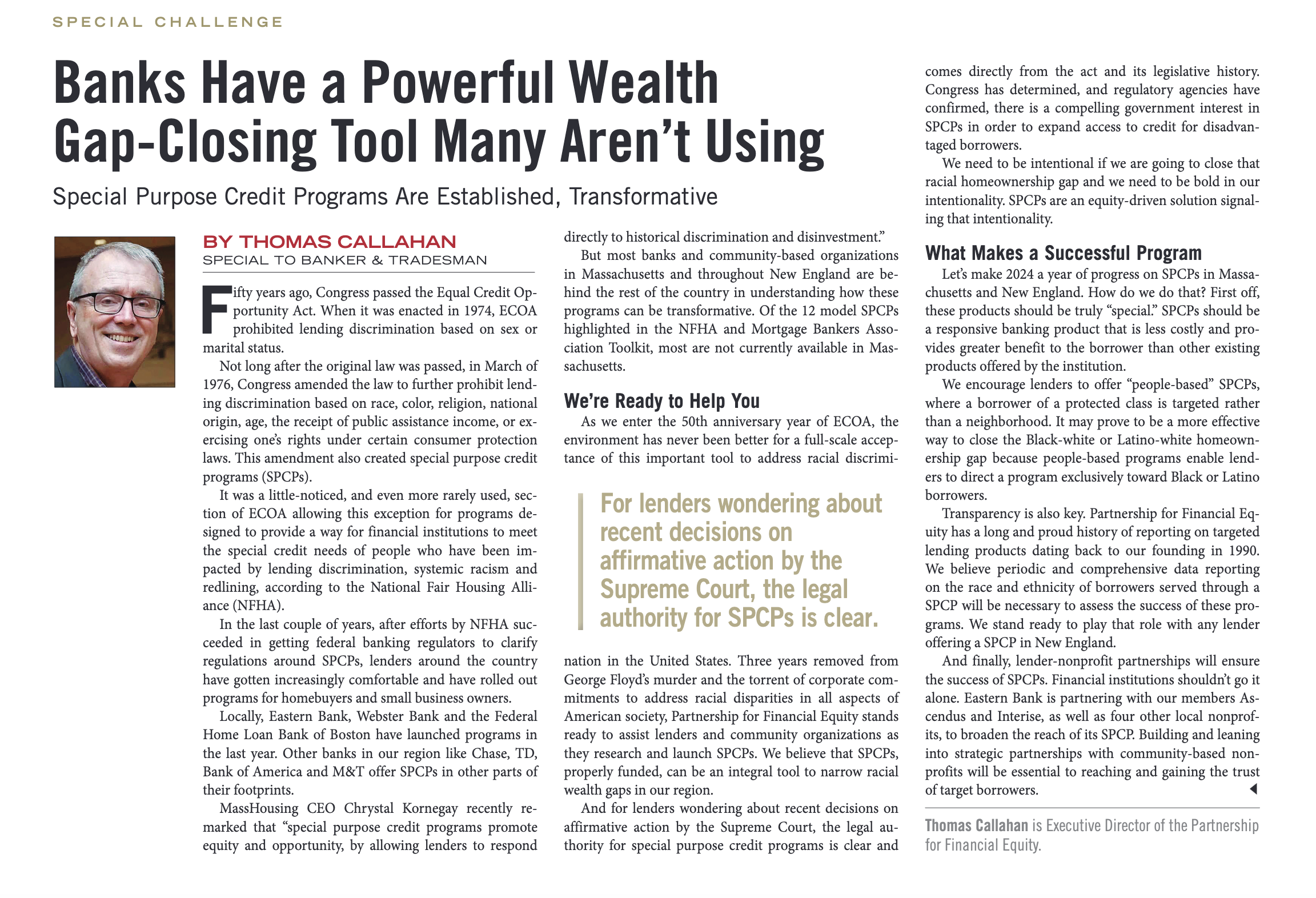
Banks Have a Powerful Tool Many Aren’t Using

Special Purpose Credit Programs Are Established, Transformative, Can Close Wealth Gap

From Banker & Tradesman January 8, 2024

Fifty years ago, Congress passed the Equal Credit Opportunity Act. When it was enacted in 1974, ECOA prohibited lending discrimination based on sex or marital status.

Not long after the original law was passed, in March of 1976, Congress amended the law to further prohibit lending discrimination based on race, color, religion, national origin, age, the receipt of public assistance income, or exercising one’s rights under certain consumer protection laws. This amendment also created special purpose credit programs (SPCPs).

It was a little-noticed, and even more rarely used, section of ECOA allowing this exception for programs designed to provide a way for financial institutions to meet the special credit needs of people who have been impacted by lending discrimination, systemic racism and redlining, according to the National Fair Housing Alliance (NFHA).

In the last couple of years, after efforts by the NFHA succeeded in getting federal banking regulators to clarify regulations around SPCPs, lenders around the country have gotten increasingly comfortable and have rolled out programs for homebuyers and small business owners.

Locally, Eastern Bank, Webster Bank and the Federal Home Loan Bank of Boston have launched programs in the last year. Other banks in our region like Chase, TD, Bank of America and M&T offer SPCPs in other parts of their footprints.

MassHousing CEO Chrystal Kornegay recently remarked that “special purpose credit programs promote equity and opportunity, by allowing lenders to respond directly to historical discrimination and disinvestment.”

But most banks and community-based organizations in Massachusetts and throughout New England are behind the rest of the country in understanding how these programs can be transformative. Of the 12 model SPCPs highlighted in the NFHA and Mortgage Bankers Association Toolkit, most are not currently available in Massachusetts.

We’re Ready to Help You

As we enter the 50th anniversary year of ECOA, the environment has never been better for a full-scale acceptance of this important tool to address racial discrimination in the United States. Three years removed from George Floyd’s murder and the torrent of corporate commitments to address racial disparities in all aspects of American society, Partnership for Financial Equity stands ready to assist lenders and community organizations as they research and launch SPCPs. We believe that SPCPs, properly funded, can be an integral tool to narrow racial wealth gaps in our region.

And for lenders wondering about recent decisions on affirmative action by the Supreme Court, the legal authority for special purpose credit programs is clear and comes directly from the act and its legislative history. Congress has determined, and regulatory agencies have confirmed, there is a compelling government interest in SPCPs in order to expand access to credit for disadvantaged borrowers.

We need to be intentional if we are going to close that racial homeownership gap and we need to be bold in our intentionality. SPCPs are an equity-driven solution signaling that intentionality.

What Makes a Successful Program

Let’s make 2024 a year of progress on SPCPs in Massachusetts and New England. How do we do that? First off, these products should be truly “special.” SPCPs should be a responsive banking product that is less costly and provides greater benefit to the borrower than other existing products offered by the institution.

We encourage lenders to offer “people-based” SPCPs, where a borrower of a protected class is targeted rather than a neighborhood. It may prove to be a more effective way to close the Black-white or Latino-white homeownership gap because people-based programs enable lenders to direct a program exclusively toward Black or Latino borrowers.

Transparency is also key. Partnership for Financial Equity has a long and proud history of reporting on targeted lending products dating back to our founding in 1990. We believe periodic and comprehensive data reporting on the race and ethnicity of borrowers served through a SPCP will be necessary to assess the success of these programs. We stand ready to play that role with any lender offering a SPCP in New England.

And finally, lender-nonprofit partnerships will ensure the success of SPCPs. Financial institutions shouldn’t go it alone. Eastern Bank is partnering with our members Ascendus and Interise, as well as four other local nonprofits, to broaden the reach of its SPCP. Building and leaning into strategic partnerships with community-based nonprofits will be essential to reaching and gaining the trust of target borrowers.

Thomas Callahan is Executive Director of the Partnership for Financial Equity.